Dharma Stories
Stories from the life of the Buddha, Jataka Tales, and the lives of those who walked the path.
Life of the Buddha
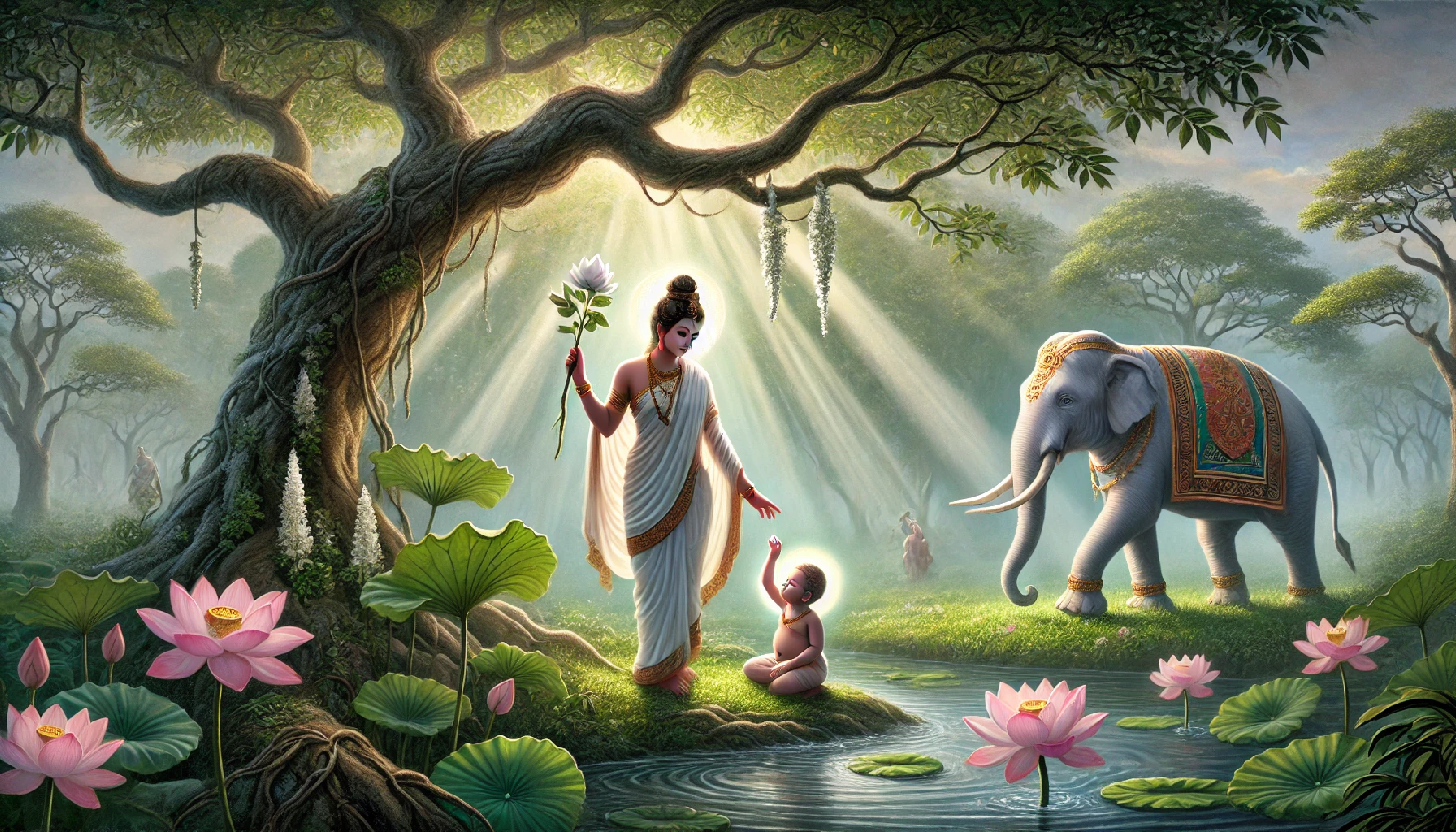
The Buddha's Birth
Story: According to Buddhist tradition, Queen Maya had a miraculous dream in which a white elephant holding a lotus flower entered her womb. The court sages interpreted this as a sign that the child would become either a great king or a fully enlightened Buddha. As the time of birth approached, Queen Maya was traveling to her parents' home when, in Lumbini Garden, she gave birth to Siddhartha Gautama while standing and holding the branch of a tree. As soon as Siddhartha was born, he took seven steps and declared, "I am the foremost in the world; this is my last birth."
Lesson: The Buddha's birth symbolizes his unique role in history. His declaration foreshadows his mission to help all beings overcome suffering and attain liberation. The white elephant and lotus in Queen Maya's dream are symbols of purity and spiritual power.
Reflection: This story invites gratitude for the rarity and significance of an enlightened teacher appearing in the world. It underscores the importance of using this human life for spiritual development.
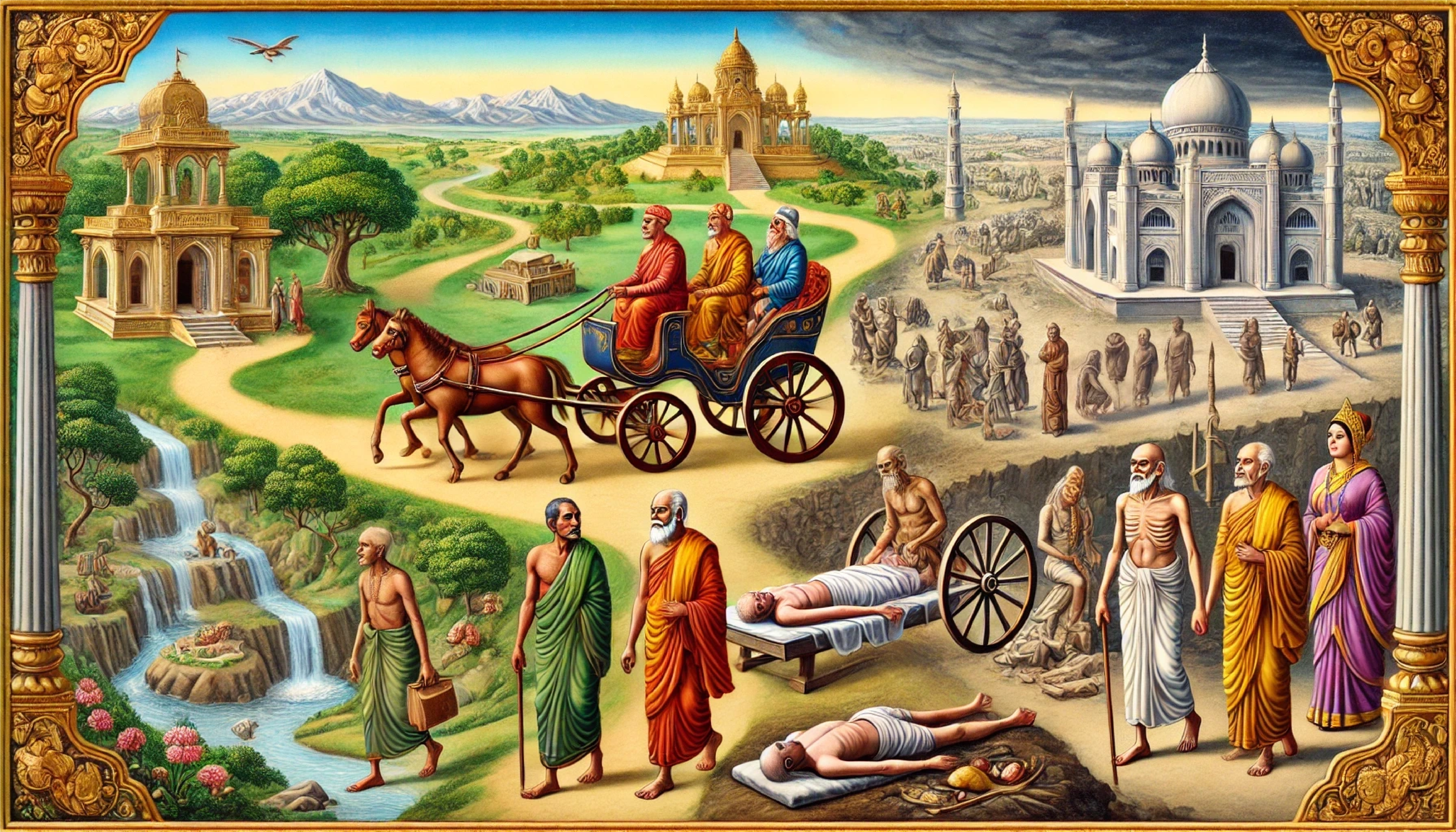
The Four Sights
Story: Prince Siddhartha grew up shielded from suffering within his father's palace. One day, he convinced his charioteer Channa to take him beyond the palace walls. On separate journeys he encountered an old man, a sick man, a corpse, and finally, a serene wandering ascetic. These Four Sights shattered his sheltered world and ignited his quest to find a path beyond suffering.
Lesson: The first three sights represent the inescapable nature of dukkha and anicca. The fourth sight — the ascetic — offers hope: that a path beyond suffering exists.
Reflection: For practitioners, the Four Sights encourage contemplation of impermanence. Recognizing the fleeting nature of life can inspire a deeper commitment to spiritual practice.
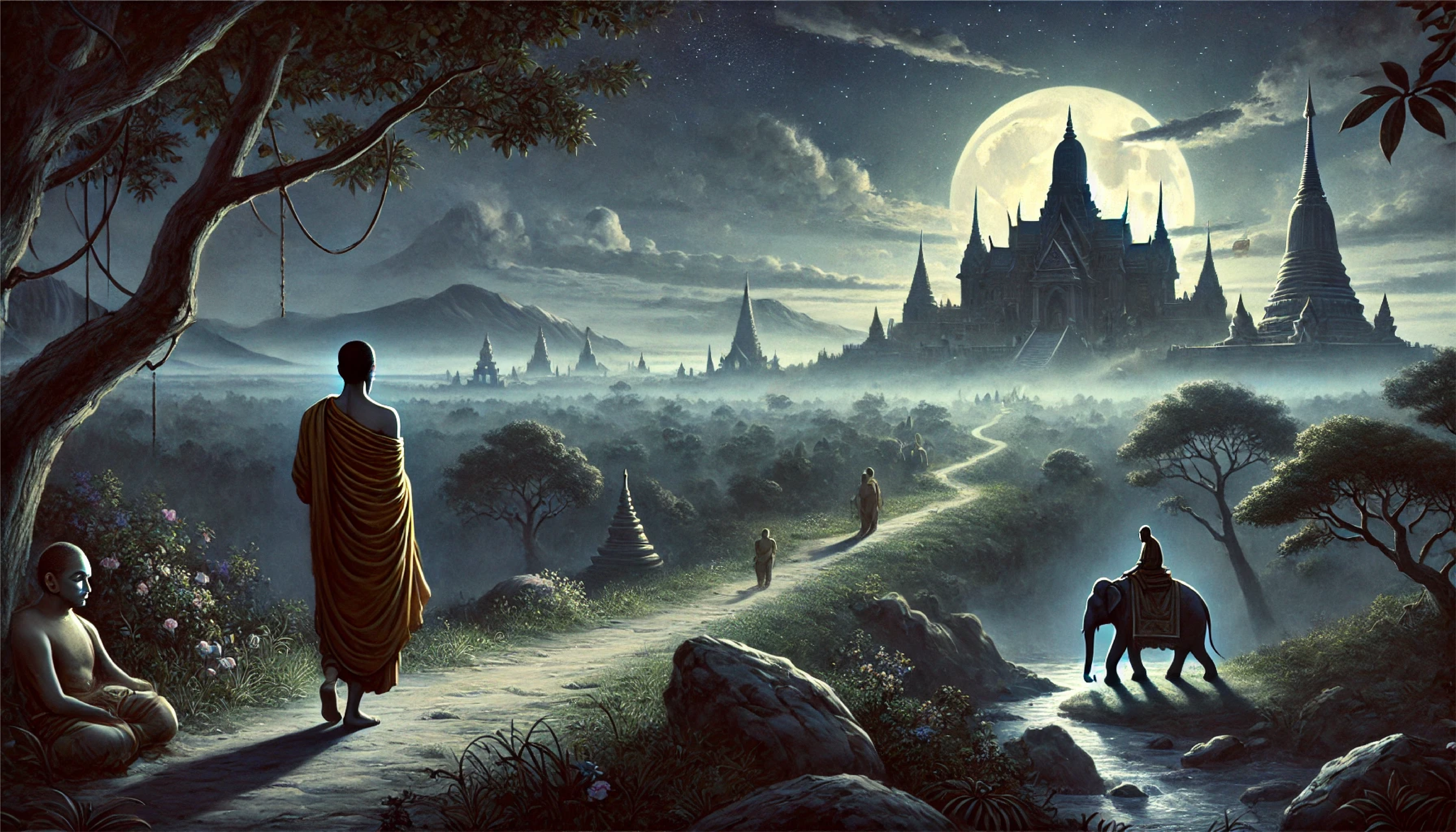
The Great Renunciation
Story: After witnessing the Four Sights, Siddhartha felt that palace life was hollow in the face of universal suffering. One night, he quietly left the palace, abandoning his royal life, his wife Yasodhara, and his newborn son Rahula. This act — the Great Renunciation — marked the beginning of his journey as a wandering ascetic. He spent the next six years in extreme self-denial, fasting until he was nearly skeletal.
Lesson: Siddhartha's renunciation teaches the importance of releasing attachment to worldly pleasures. It highlights the Buddha's willingness to sacrifice everything in pursuit of truth. Yet his eventual rejection of extreme asceticism in favor of the Middle Way is equally important.
Reflection: The Great Renunciation challenges us to examine our own attachments — not necessarily to renounce them all, but to see which ones block our growth on the spiritual path.
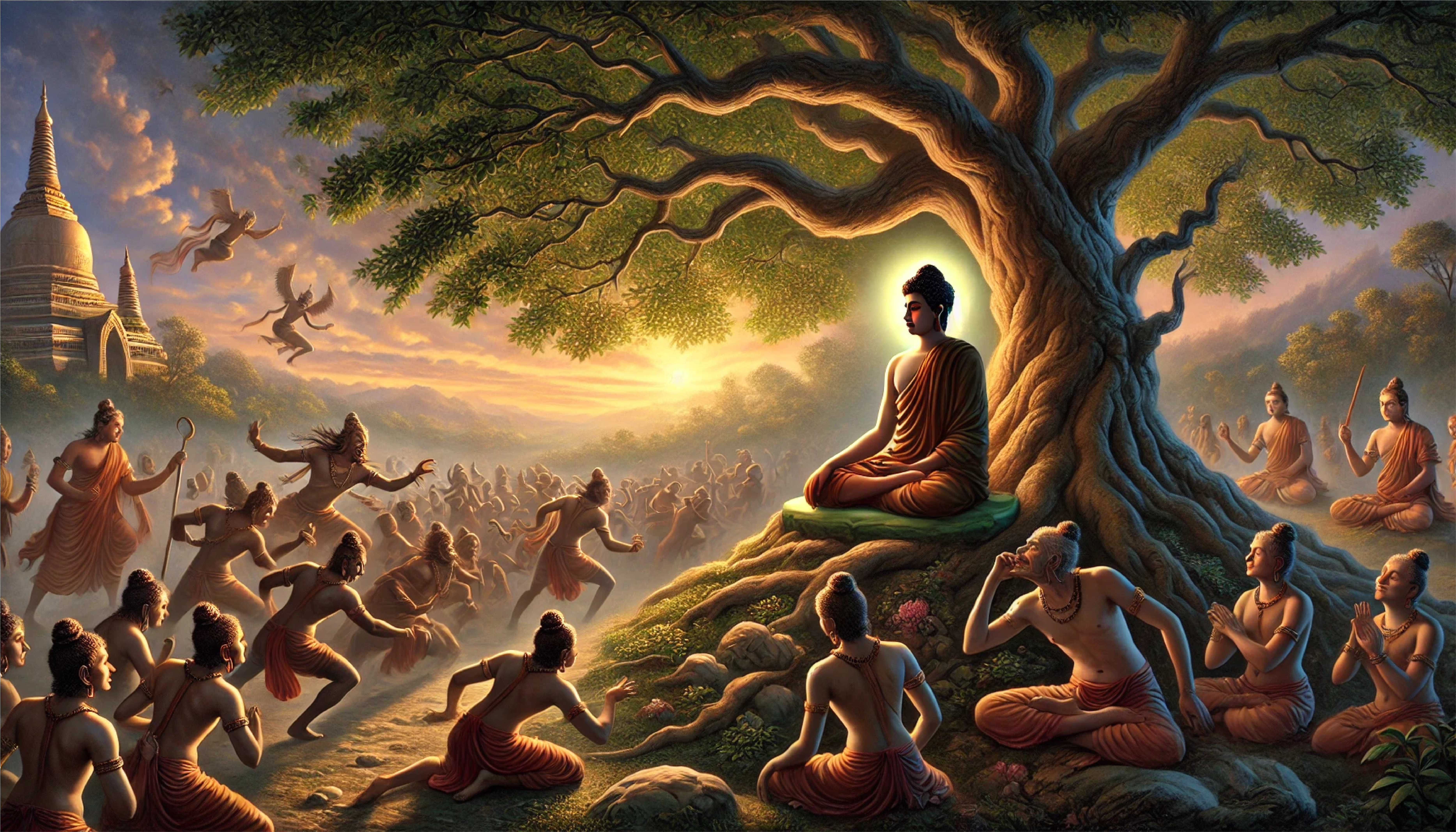
The Buddha's Enlightenment
Story: After realizing that extreme asceticism was not the way, Siddhartha adopted the Middle Way — a path of moderation. He sat beneath the Bodhi tree in Bodh Gaya, vowing not to rise until he had achieved enlightenment. Through the night, Mara assailed him with temptations, fears, and doubts. Siddhartha remained unmoved. As the morning star rose, he attained full enlightenment, realizing the true nature of reality and the cessation of suffering.
Lesson: The Middle Way teaches balance — neither indulgence nor self-torture, but wise and steady practice. The Buddha's victory over Mara symbolizes overcoming the inner forces of greed, hatred, and delusion.
Reflection: The Bodhi tree moment reminds us that liberation is available in this very life — but it requires unwavering commitment and a willingness to face our inner obstacles honestly.
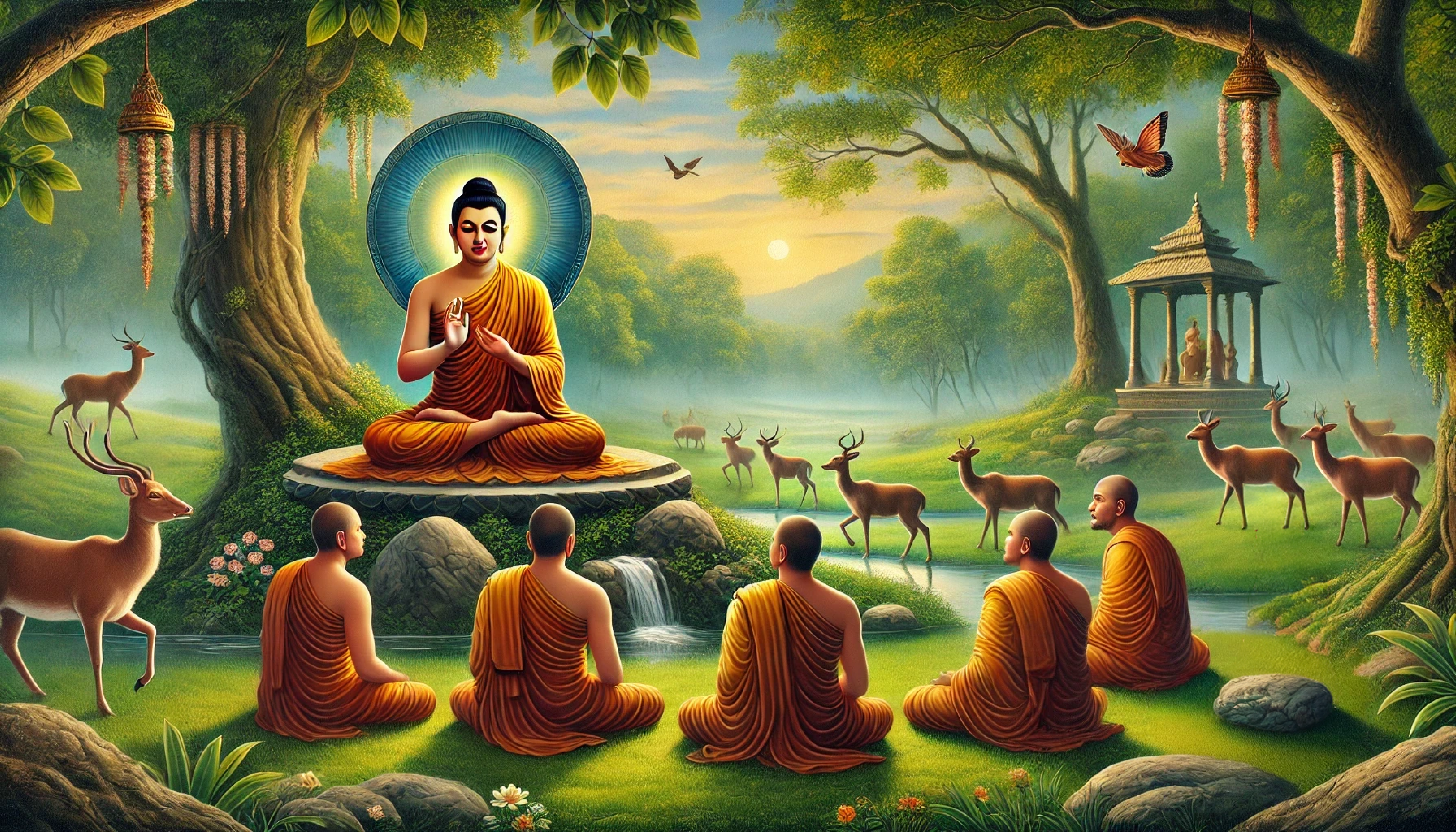
The First Sermon at Deer Park
Story: After his enlightenment, the Buddha was initially reluctant to teach, fearing the truth he had realized was too subtle. Persuaded by the god Brahma Sahampati, he traveled to the Deer Park in Sarnath where he found five former companions. To them he delivered his first discourse — the Dhammacakkappavattana Sutta — explaining the Four Noble Truths and the Noble Eightfold Path.
Lesson: The Four Noble Truths diagnose the problem of dukkha and prescribe the path to end it. The Noble Eightfold Path offers practical guidance on ethics, wisdom, and mental discipline.
Reflection: This first sermon marks the beginning of the Sangha. It reminds us that the Dhamma is not mystical abstraction but a practical path walked by real people across twenty-five centuries.
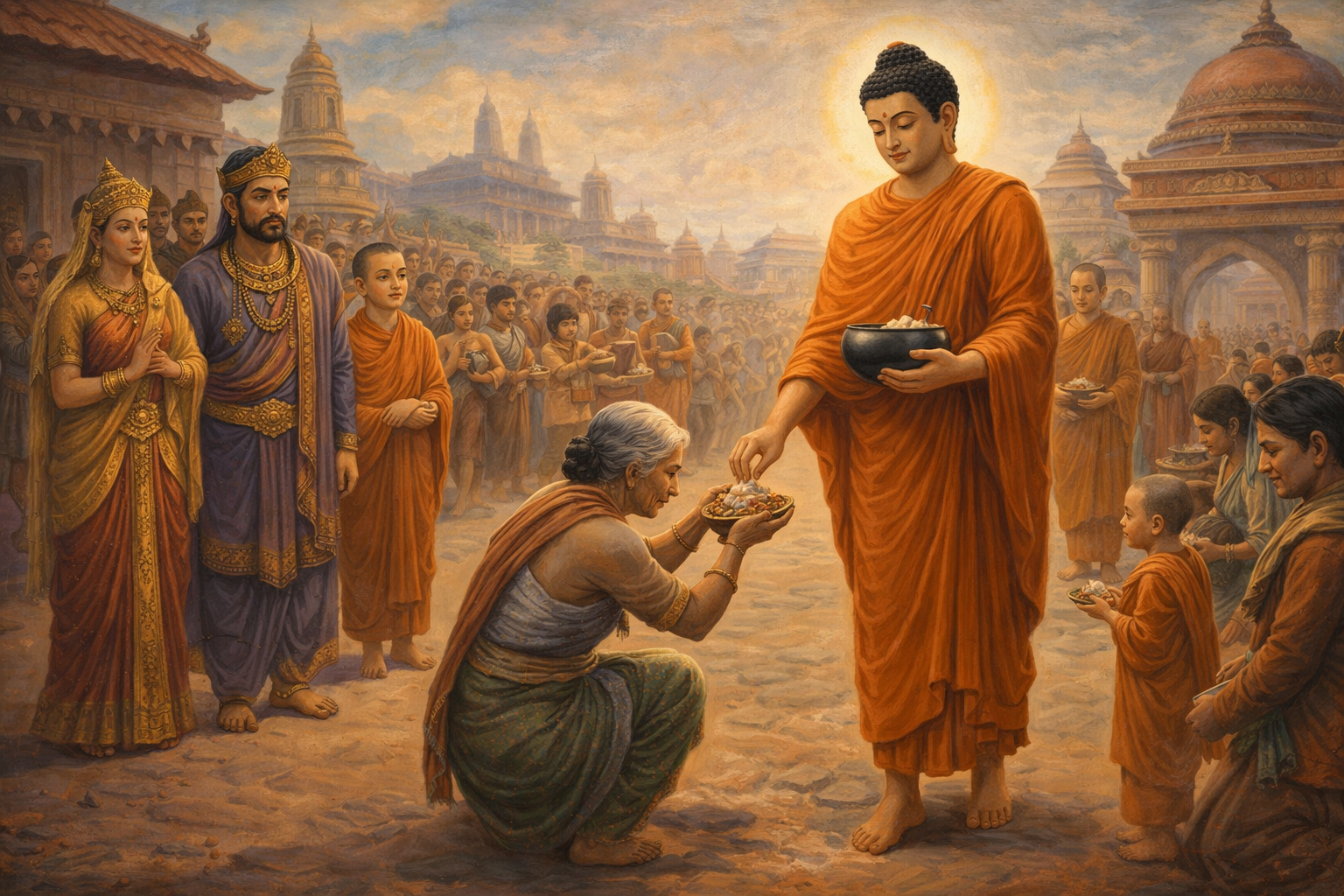
The Buddha Returns to Kapilavastu
Story: One year after his enlightenment, the Buddha returned to his home city of Kapilavastu. His father, King Suddhodana, had expected his son to arrive in royal style — but the Buddha walked through the city on his alms round, bowl in hand, receiving food from strangers. The king was deeply wounded by what seemed to be humiliation. The Buddha explained gently: "This, great king, is the custom of my lineage." He was not speaking of the Sakya royal lineage, but of the lineage of Buddhas across all ages. Suddhodana was so moved by this teaching that he attained stream-entry on the spot. The visit also became the occasion for the Buddha's reunion with Yasodhara and his ordination of their son Rahula as a novice monk — at Yasodhara's request.
Lesson: The Buddha did not return to claim a throne or receive royal honors — he returned as a teacher, on equal terms with the humblest citizen. This embodies upekkha and the freedom that comes from having released all status and pride.
Reflection: When we return to our families after growth or transformation, we sometimes face the pain of not being recognized as we now are. The Buddha's return shows us that the response to this is not resentment but gentle, patient teaching — and that the deepest gift we can offer is our genuine presence.
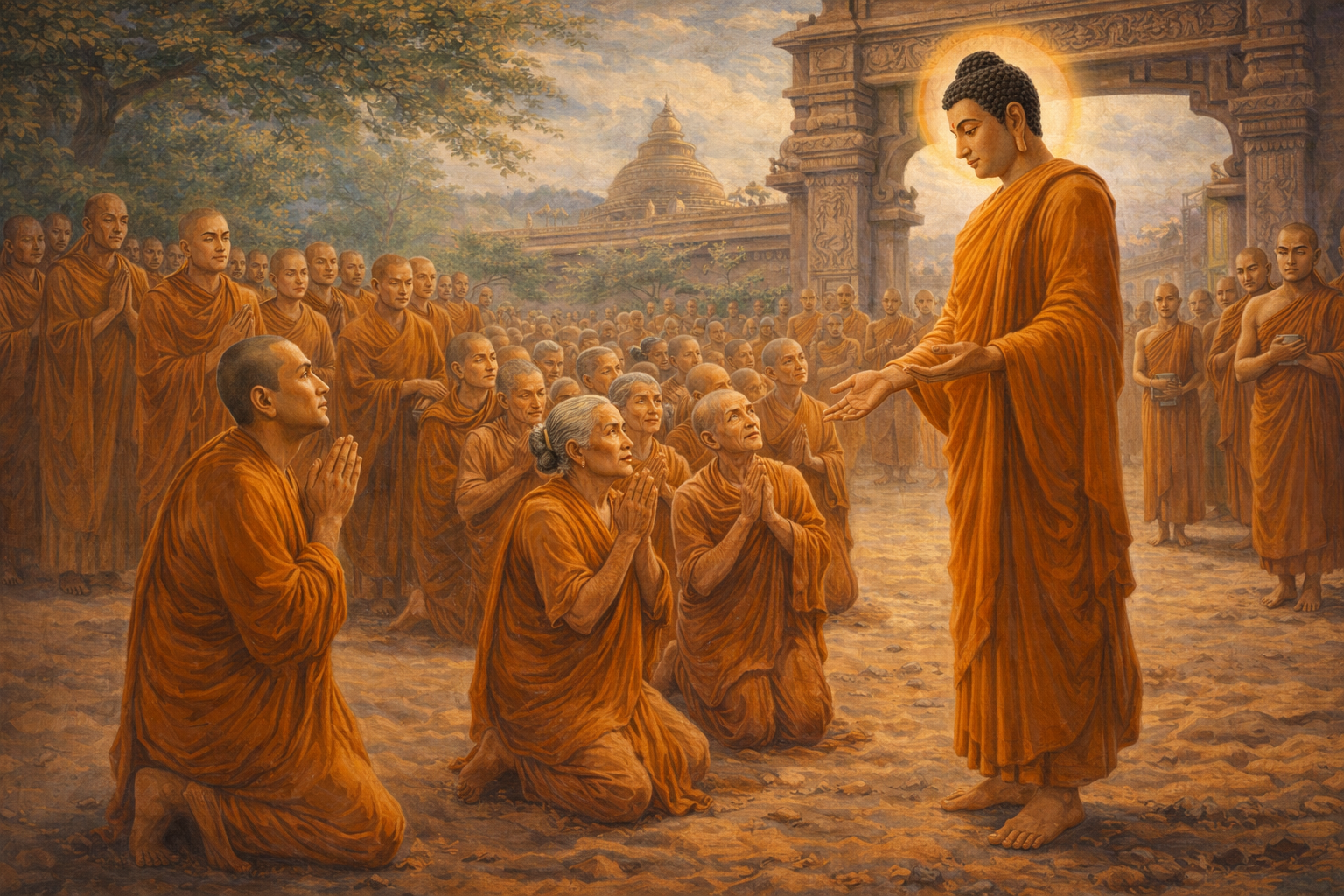
The Formation of the Bhikkhunī Sangha
Story: After the Buddha's father, King Suddhodana, passed away, his stepmother and aunt Mahapajapati Gotami approached the Buddha and asked to be ordained as a nun. The Buddha initially declined three times, without giving a reason. Undaunted, Mahapajapati gathered 500 women of the Sakya clan, and they shaved their heads, put on ochre robes, and walked barefoot the long road to Vesali where the Buddha was staying. When Ananda found them exhausted and weeping outside the monastery gate, he took up their cause and petitioned the Buddha on their behalf three times. At last the Buddha agreed — with the condition that the nuns would observe additional rules governing their relationship to the monks' community. Mahapajapati accepted, and the Bhikkhunī Sangha was founded. She herself became the first fully ordained woman in Buddhist history and eventually attained enlightenment.
Lesson: The founding of the Bhikkhunī Sangha established the principle that the path to liberation is equally available to all people, regardless of gender. Ananda's compassionate advocacy and Mahapajapati's extraordinary perseverance made this possible.
Reflection: There are times when the door to what we need most remains closed despite our sincerest effort. Mahapajapati's example shows us what perseverance grounded in deep intention looks like — and what becomes possible when others stand beside us at the gate.
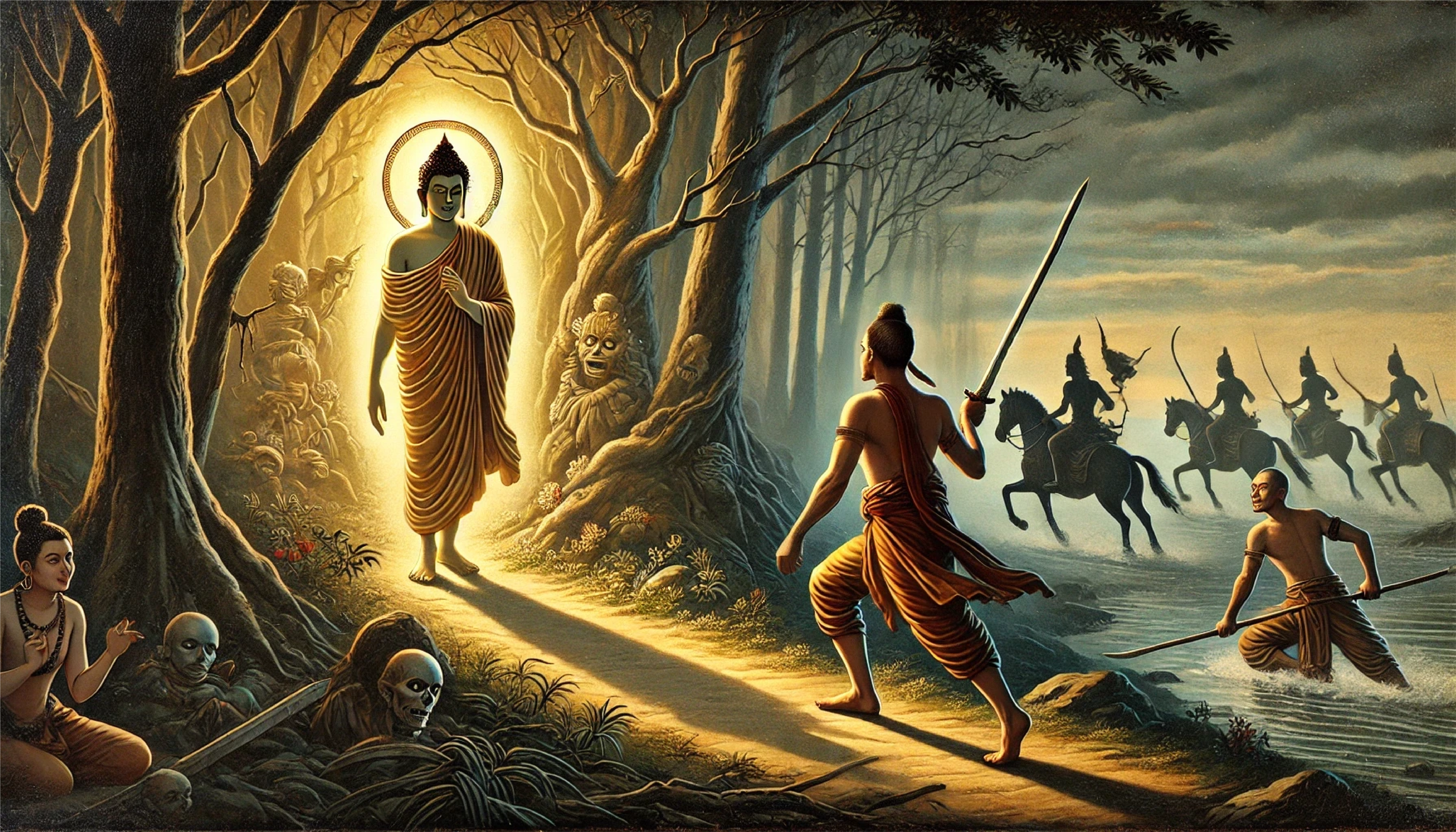
The Story of Angulimala
Story: Angulimala was a notorious bandit who had killed hundreds of people and wore a necklace of their fingers, believing he needed to kill 1,000 to gain ultimate power. When he attempted to kill the Buddha, he could not catch him no matter how fast he ran. Astonished, he called out to the Buddha to stop. The Buddha replied, "I have already stopped, Angulimala — it is you who has not stopped." These words pierced him deeply. Angulimala renounced his ways, became a monk, and through dedicated practice eventually attained Nibbana.
Lesson: This story illustrates the power of kamma and its possibility of transformation. Anyone, regardless of past actions, can change course and reach liberation.
Reflection: Angulimala's transformation is a testament to the power of the Dhamma. It encourages us never to give up on ourselves or others, no matter how deep the negative patterns seem.
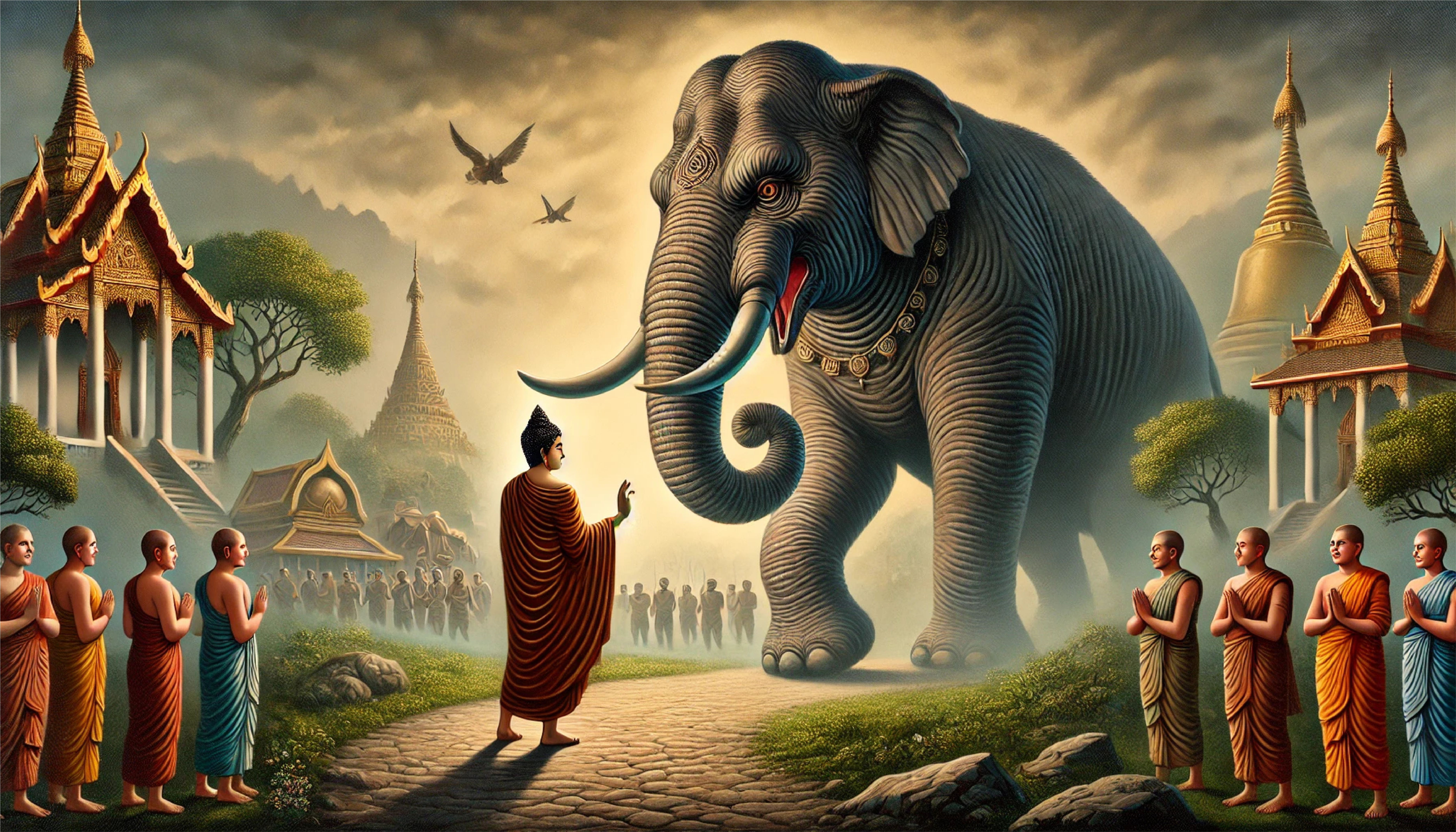
The Buddha Tames Nalagiri the Elephant
Story: Devadatta, the Buddha's jealous cousin, released a fierce drunken elephant named Nalagiri to trample the Buddha in the streets of Rajagaha. Instead of fleeing, the Buddha stood still and radiated metta toward the charging elephant. Upon encountering the Buddha's utterly calm, compassionate presence, Nalagiri immediately slowed, bowed his head, and was tamed. The crowd watching from rooftops burst into joyful cries.
Lesson: Even a wild, enraged creature can be tamed by the force of loving-kindness. True strength lies in inner peace and compassion — not in aggression or flight.
Reflection: When we face hostility or aggression in our own lives, Nalagiri's story reminds us: the most powerful response is often not to fight or to flee, but to remain grounded in genuine goodwill.
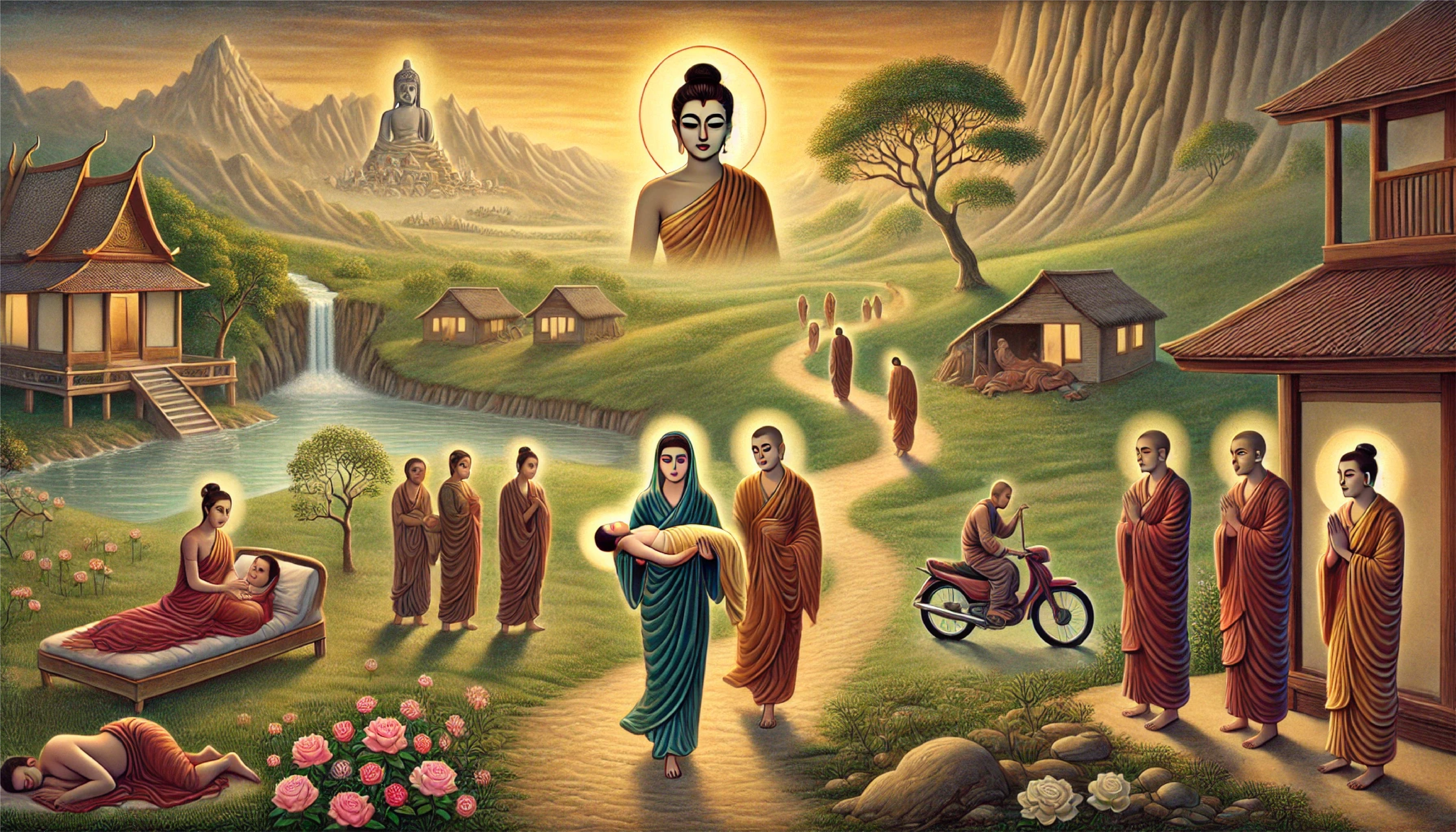
Kisa Gotami and the Mustard Seed
Story: Kisa Gotami was a young mother devastated by the sudden death of her only son. Carrying his body, she went to the Buddha begging for medicine to bring him back. The Buddha told her to bring a mustard seed from a household that had never known death. She went from door to door across the entire city — and found that every single family had lost someone they loved. She returned empty-handed and deeply changed. She buried her son, became the Buddha's disciple, and eventually attained enlightenment.
Lesson: This story teaches the universality of suffering and the liberating power of anicca. The Buddha did not remove Kisa Gotami's grief — he helped her see it in its proper context.
Reflection: When we are consumed by grief, it can feel like we alone have suffered. Kisa Gotami's journey reminds us that loss is woven into the fabric of human life — and that this shared truth, when truly understood, becomes a doorway to compassion.
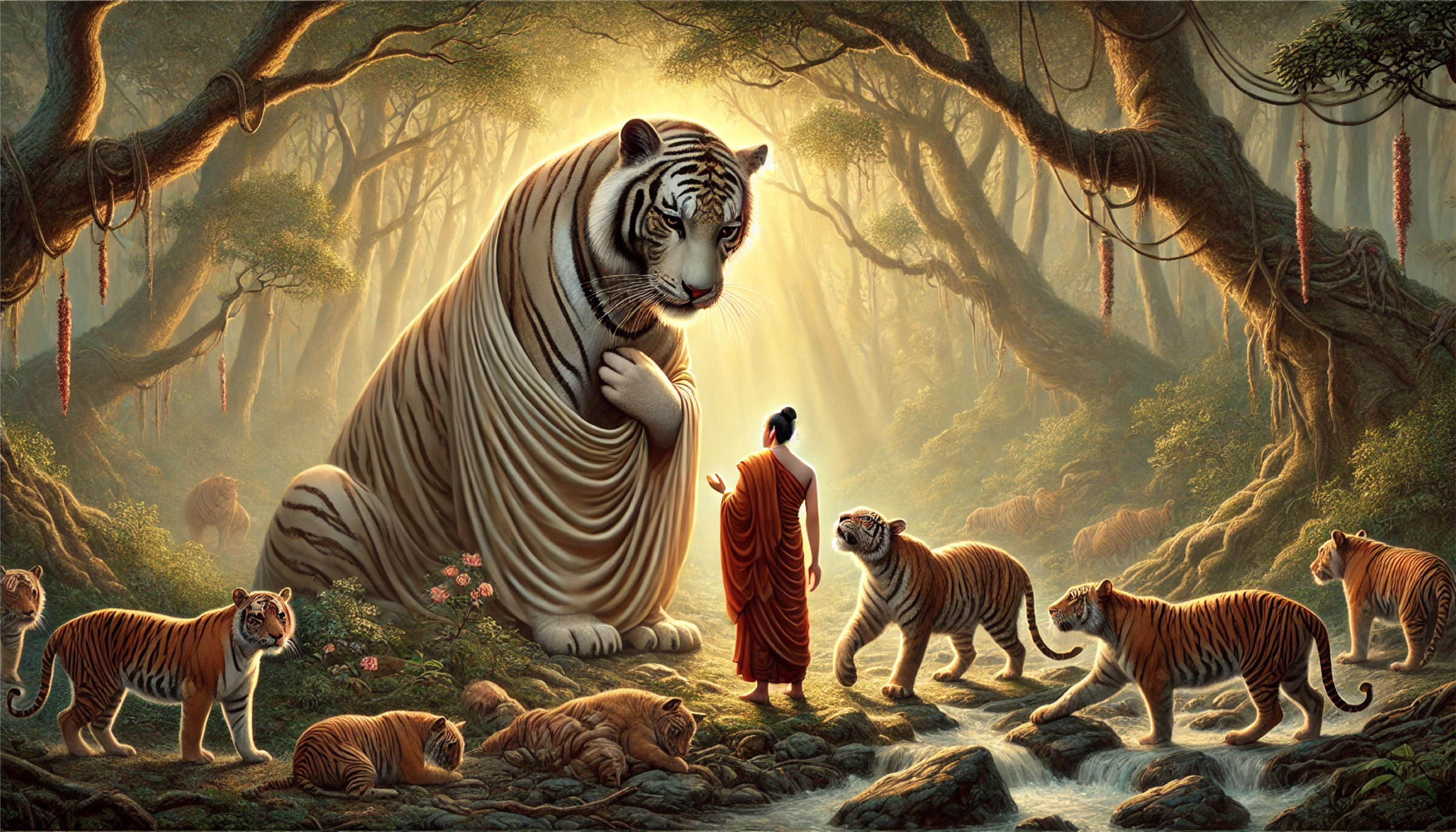
The Hungry Tigress
Story: In one of his past lives as a Bodhisatta, the Buddha encountered a starving tigress on the verge of eating her own cubs out of desperation. Moved by compassion, he offered his own body as food, allowing her to eat him and save her cubs. This selfless act was one of many sacrifices in his long journey toward Buddhahood.
Lesson: The Jataka tales illustrate the development of the paramis necessary for Buddhahood. This story embodies the perfection of dana and karuna.
Reflection: The Hungry Tigress shows that the journey to enlightenment is not only about personal liberation — it is inseparable from the liberation of others. Compassion and wisdom, fully developed, become one.
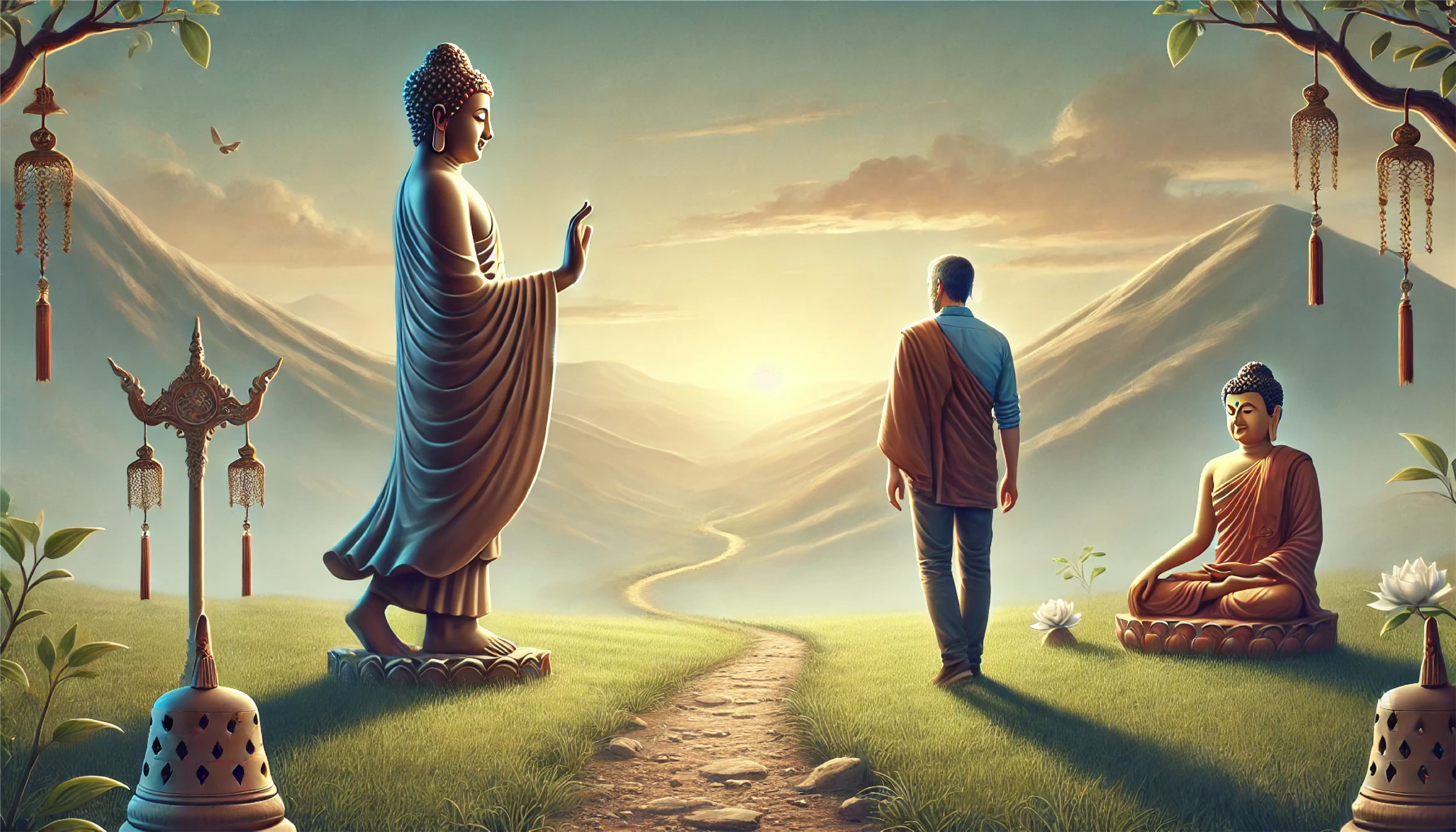
The Parable of the Raft
Story: The Buddha told of a man who built a raft to cross a dangerous river. Having reached the far shore safely, he faced a choice: carry the heavy raft on his back for the rest of the journey, or leave it behind. The Buddha explained that the Dhamma is like that raft — it carries you across from the shore of ignorance to the shore of wisdom. But once you have crossed, clinging to the raft only becomes a burden.
Lesson: Even the teachings themselves must not become an object of clinging. The Dhamma is a tool, not an end in itself. This principle of anatta extends even to the path that reveals it.
Reflection: This parable challenges spiritual pride and dogmatism. The goal is liberation — not being the most learned student of the path. All methods, however beautiful, are ultimately fingers pointing at the moon.
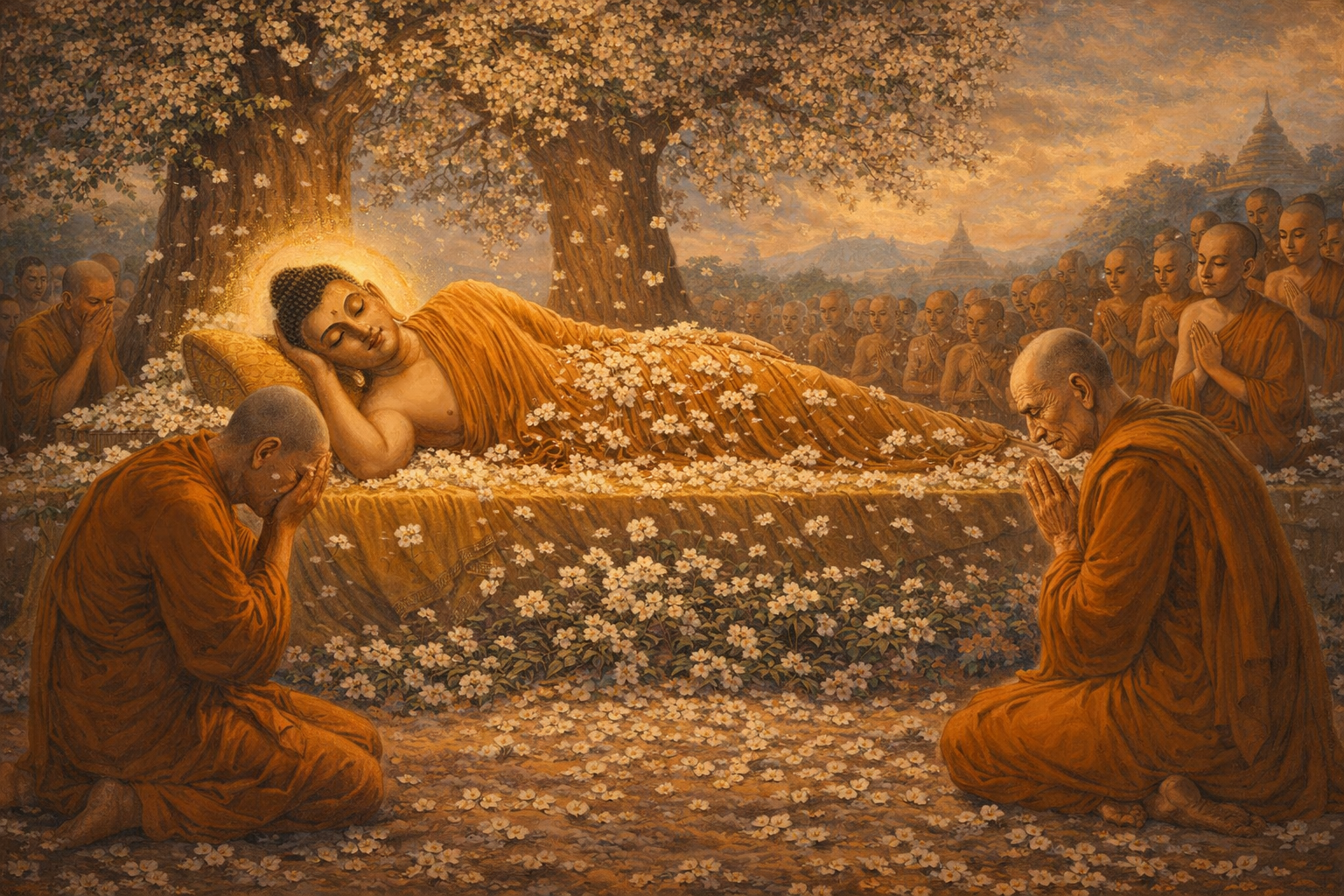
The Parinibbāna — The Buddha's Final Passing
Story: In his eightieth year, the Buddha traveled north toward the sal tree grove of Kushinagar, knowing his death was near. He lay down between two sal trees in the lion's pose — on his right side, facing west — and spoke his final words to the assembled monks: "All conditioned things are impermanent. Work out your salvation with diligence." He then entered progressively deeper states of meditation and passed into final Parinibbana. The sal trees bloomed out of season, raining flowers over his body. Ananda wept. The elderly monk Subhadda became his last disciple, ordained just hours before his passing. After seven days, the Buddha's body was cremated with the honors of a Wheel-Turning King. His relics were distributed among eight kingdoms and enshrined in stupas, where they have been venerated by millions across twenty-five centuries.
Lesson: The Buddha's death is not a tragedy — it is the final, perfect demonstration of his teaching. He did not cling to life. He died as he had lived: in full awareness, with complete equanimity. His last words are among the most important in all of Buddhist scripture: impermanence is the nature of all things. Work with diligence.
Reflection: The Parinibbana asks us the most important question of our lives: are we working with diligence, or are we waiting for a better moment that may never come? The Buddha's death is not the end of the Dhamma. The teaching continues — in the scriptures, in the Sangha, and in each person who practices sincerely.
Jataka Tales
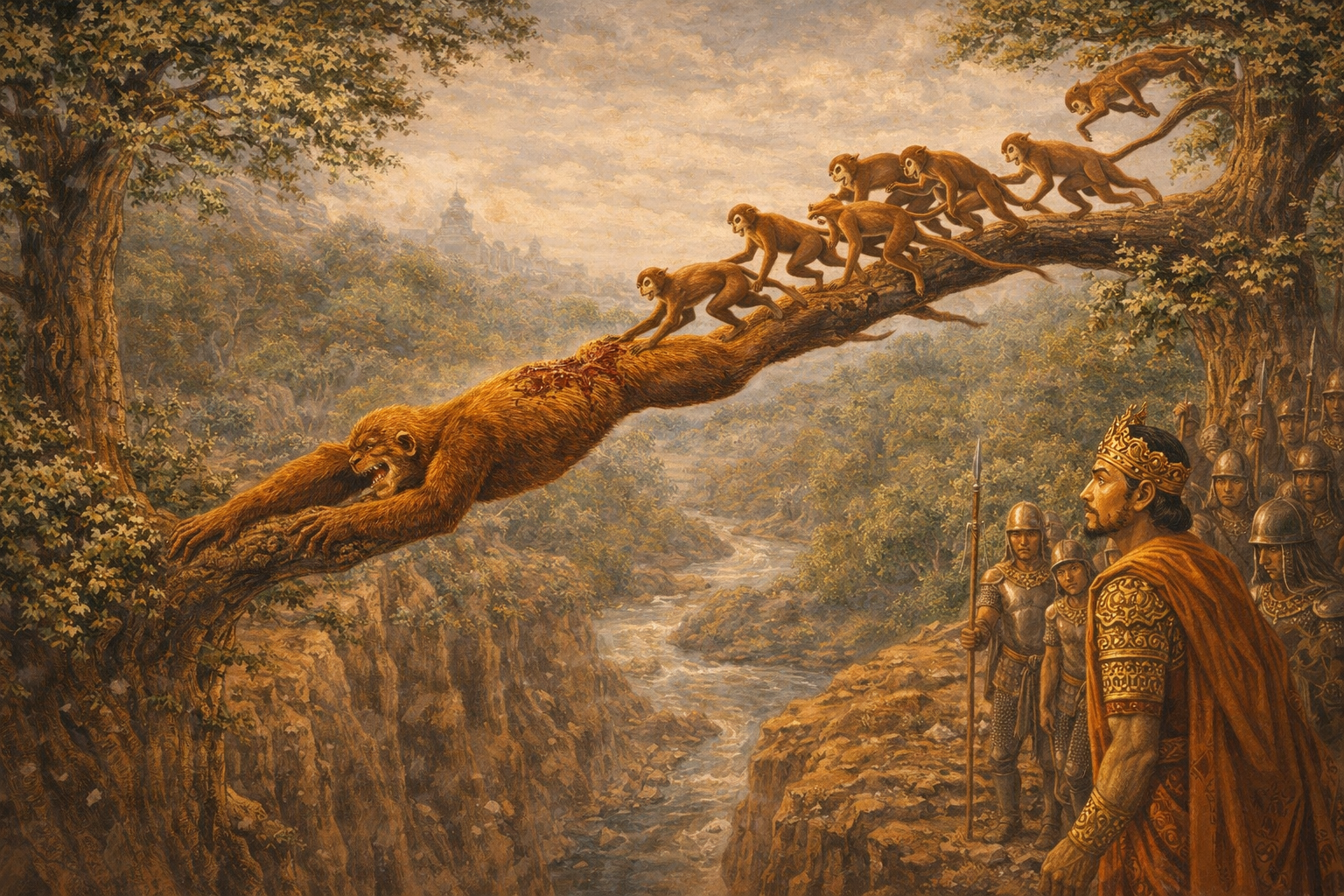
The Monkey King (Mahakapi Jataka)
Story: In a past life, the Bodhisatta was born as a great monkey king who led a troop of 80,000 monkeys near a magnificent mango tree on the banks of the Ganges. He warned his troop never to let a mango fall into the river below, lest humans discover the tree. But one fruit fell and floated downstream to the king of Varanasi, who was enchanted by its sweetness and led his army upriver to find its source. The monkeys fled in panic to the treetops and found themselves trapped on a cliff over a chasm. The Monkey King stretched his body as a living bridge between two trees, telling his troop to run across his back to safety. Every monkey escaped — but each one's weight weakened him further. Devadatta, his jealous cousin, leaped hard on his back and mortally wounded him. The human king, moved to tears by the sacrifice he had witnessed, carried the Monkey King down tenderly and asked why he gave his life for the others. "I was their king," the Monkey King replied with his last breath. "A king's duty is to protect his people — not to live at their expense."
Lesson: True leadership is selfless service. The Monkey King did not save himself and abandon his troop — he made his body a bridge so that others could cross. This story illustrates the parami of sīla and the perfection of self-sacrifice.
Reflection: What does it mean to lead? In our families, workplaces, and communities, we are all leaders of something. The Monkey King's example asks us: do we protect those in our care, even when it costs us?
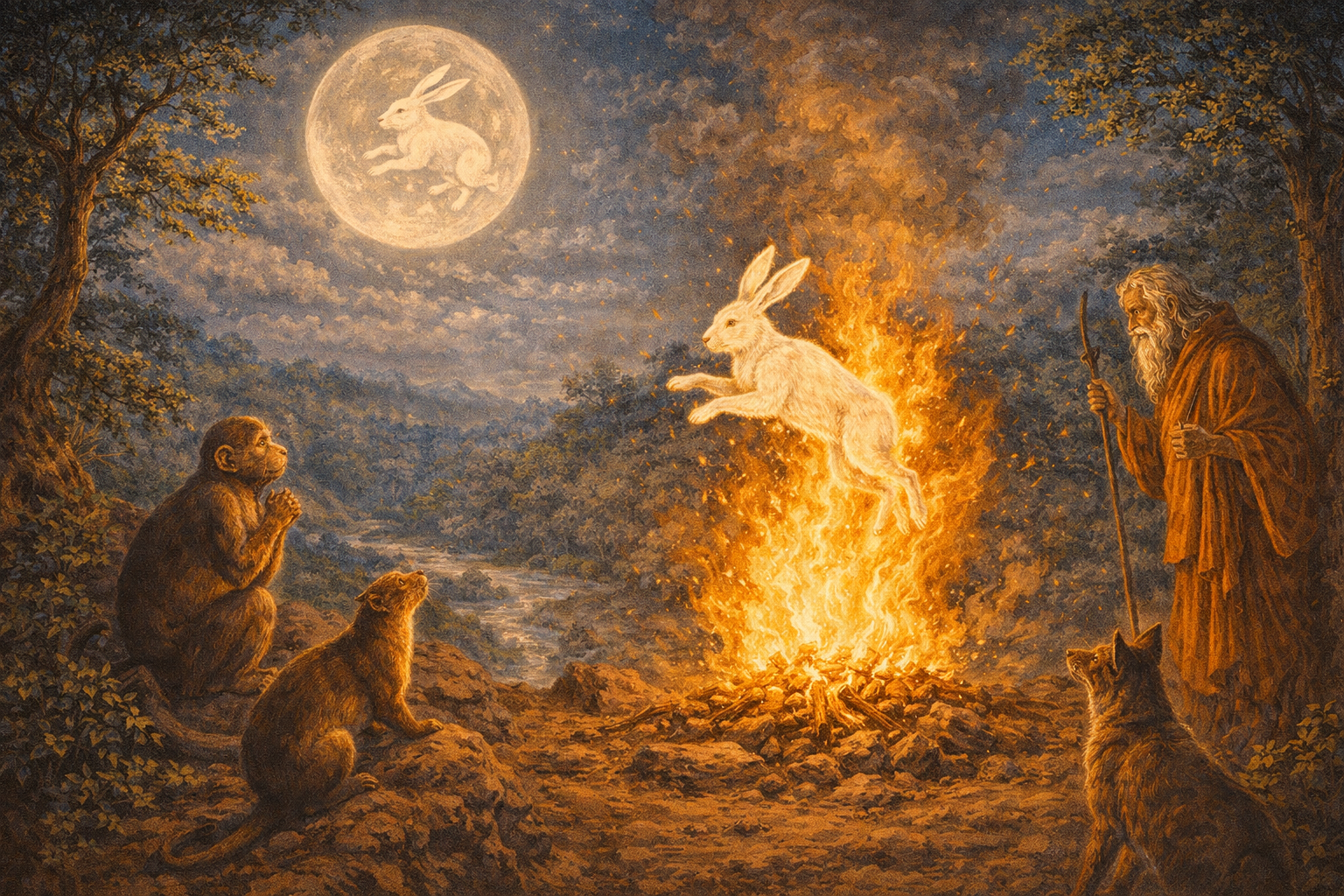
The Hare in the Moon (Sasa Jataka)
Story: In a past life, the Bodhisatta was born as a hare who lived in the forest with three friends — a monkey, an otter, and a jackal. On the eve of a holy fast day, the hare resolved that if a beggar came to him, he would offer his own body as food, since he had nothing else to give. Sakka, the king of the gods, heard this thought and disguised himself as a wandering brahmin to test all four animals. The otter, the jackal, and the monkey each brought what food they had. When the brahmin reached the hare, the hare asked him to build a fire and then leaped joyfully into the flames — but the flames turned cold and could not burn him. Sakka revealed himself, and deeply moved by the hare's boundless generosity, he painted the image of the hare onto the face of the moon, where it can still be seen today.
Lesson: True dana gives without calculation. The hare had nothing material to offer, so he offered himself. This extreme act of generosity demonstrates that what matters is the wholehearted intention behind giving.
Reflection: Next time you look at the full moon, remember the hare. When we feel we have nothing to offer, we can still offer our time, our care, and our presence. Generosity is always available to us.
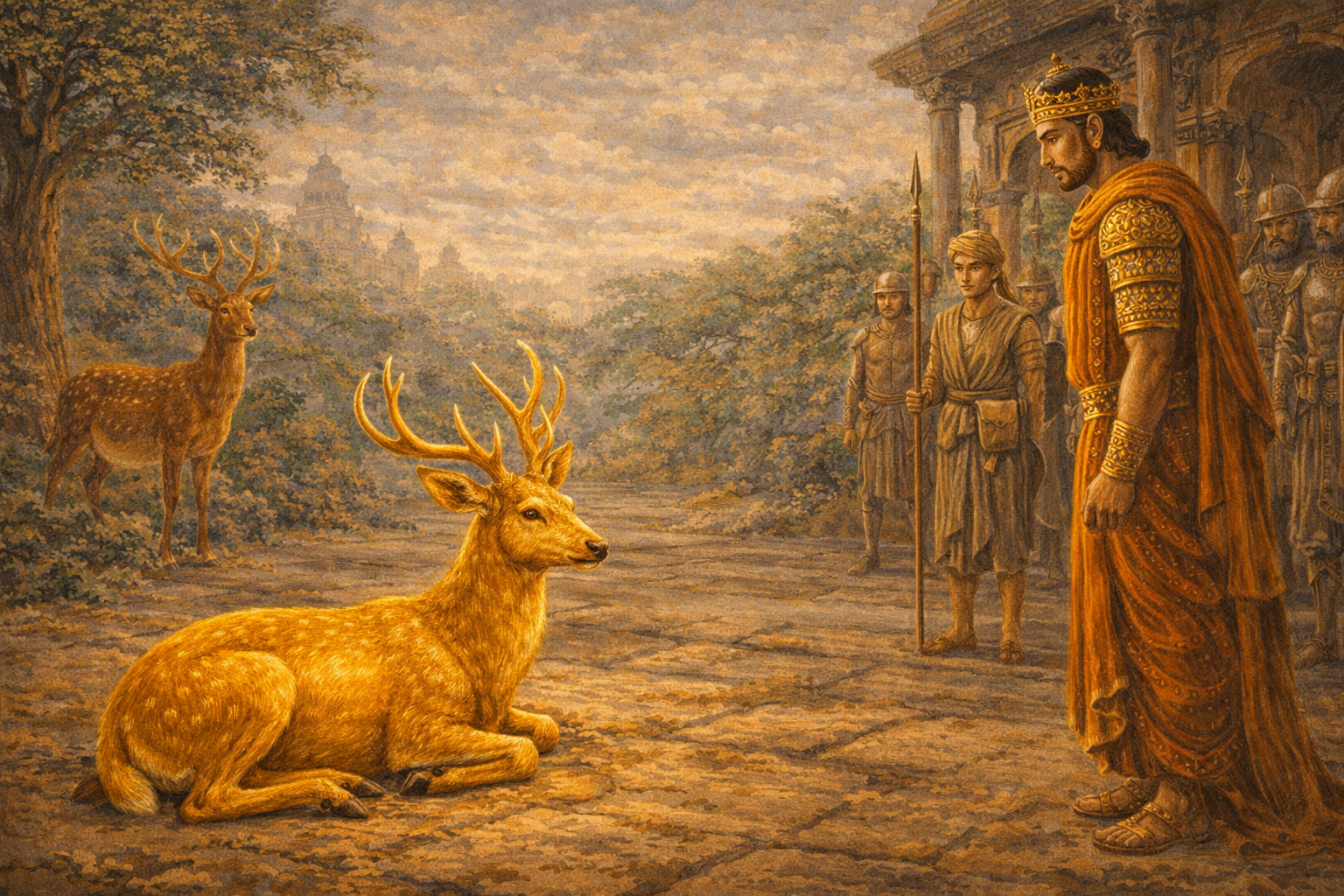
The Banyan Deer (Nigrodhamiga Jataka)
Story: In a past life, the Bodhisatta was born as a golden deer leading a herd of 500. A nearby herd was led by a deer called Sakka's Deer. The king of Varanasi loved to hunt, and his hunts terrorized both herds daily. The two deer kings proposed an arrangement to the king: each day, one deer from each herd would go voluntarily to the palace kitchen, sparing the rest from the terror of the hunt. The king agreed. One day the lot fell on a pregnant doe from the other herd. She begged Sakka's Deer to delay her turn until her fawn was born, but he refused. In desperation, she went to the golden deer. Moved by karuṇā, he offered himself in her place. When the king found the golden deer lying in submission before his kitchen, he was astonished. Hearing the story, he was so moved that he proclaimed no more deer — and eventually no more animals of any kind — would be hunted in his kingdom.
Lesson: One act of genuine compassion, taken at personal cost, can ripple outward in ways we cannot foresee. The golden deer's courage inspired a king to extend mercy to all creatures.
Reflection: Are there moments in your life when you have the strength to step in for someone more vulnerable? The golden deer's example shows that courage and compassion, combined, can change entire communities.

The Quail's Fire Charm (Vaṭṭaka Jataka)
Story: In a past life, the Bodhisatta was born as a tiny quail chick in a forest nest. Unable to fly or even walk, he depended entirely on his parents for food. One day, a great wildfire swept through the forest. All the other animals fled. The quail chick could not escape. With complete calm, he reflected on the truth of his situation — he had no hands, no feet, had never fed himself, had never acted with anything but purity of heart. He made a declaration of truth: "By the power of this truth, by the power of my own purity of intention — let this fire turn back." The fire immediately stopped and retreated, unable to cross a circle around the nest. That spot was never again touched by fire, and came to be known as the Quail's Hearth.
Lesson: The power of truth (sacca) and pure intention can be stronger than physical force. When one is completely sincere, without hidden motives, the force of that sincerity becomes a protection.
Reflection: When we face overwhelming circumstances, our inner purity and alignment with truth can be our deepest source of strength. The quail had no power except the power of a clear conscience — and it was enough.
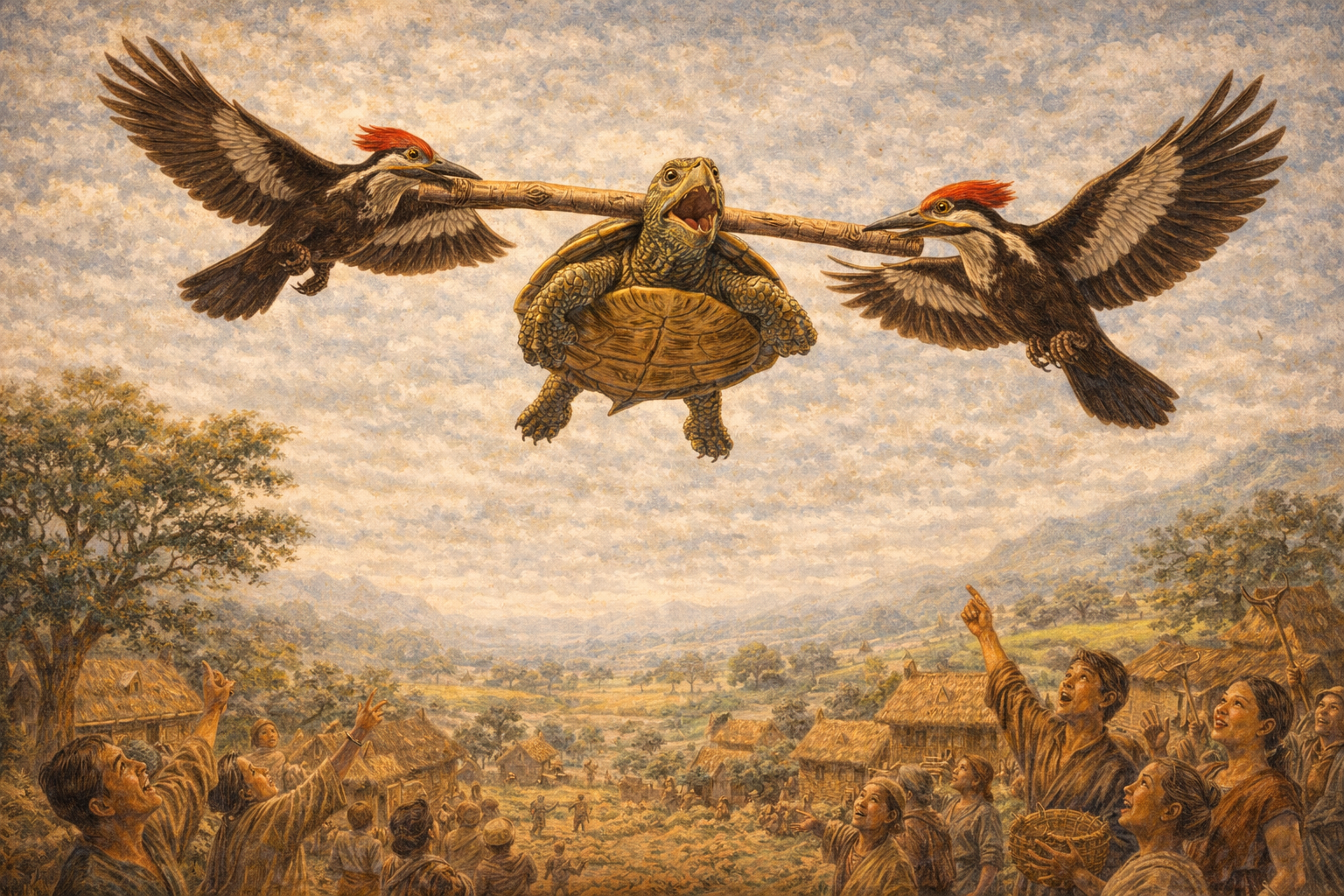
The Turtle Who Talked Too Much (Kacchapa Jataka)
Story: In a past life, the Bodhisatta was born as a woodpecker who befriended a turtle living in a lake. As drought approached, the lake began to dry up. The woodpecker offered to carry the turtle to a new lake by holding a stick in his beak while the turtle bit the middle with its mouth. "But," the woodpecker warned carefully, "you must not open your mouth to speak — no matter what you see, no matter what anyone says, not for any reason at all." The turtle agreed. As the two flew over a village, people below looked up in astonishment and burst into noisy chatter about the extraordinary sight. The turtle, unable to contain his curiosity, opened his mouth to ask what all the fuss was about — and fell to his death.
Lesson: Restraint in speech is a form of wisdom. The turtle's downfall came not from malice or foolishness, but from a simple inability to remain quiet at a critical moment. Good advice, once accepted, must be followed through.
Reflection: How often do we create our own problems by speaking when silence would serve us better? This gentle story reminds us that knowing when to stay quiet is itself a spiritual practice — and that even well-meaning speech, at the wrong moment, can have serious consequences.
Stories of the Disciples
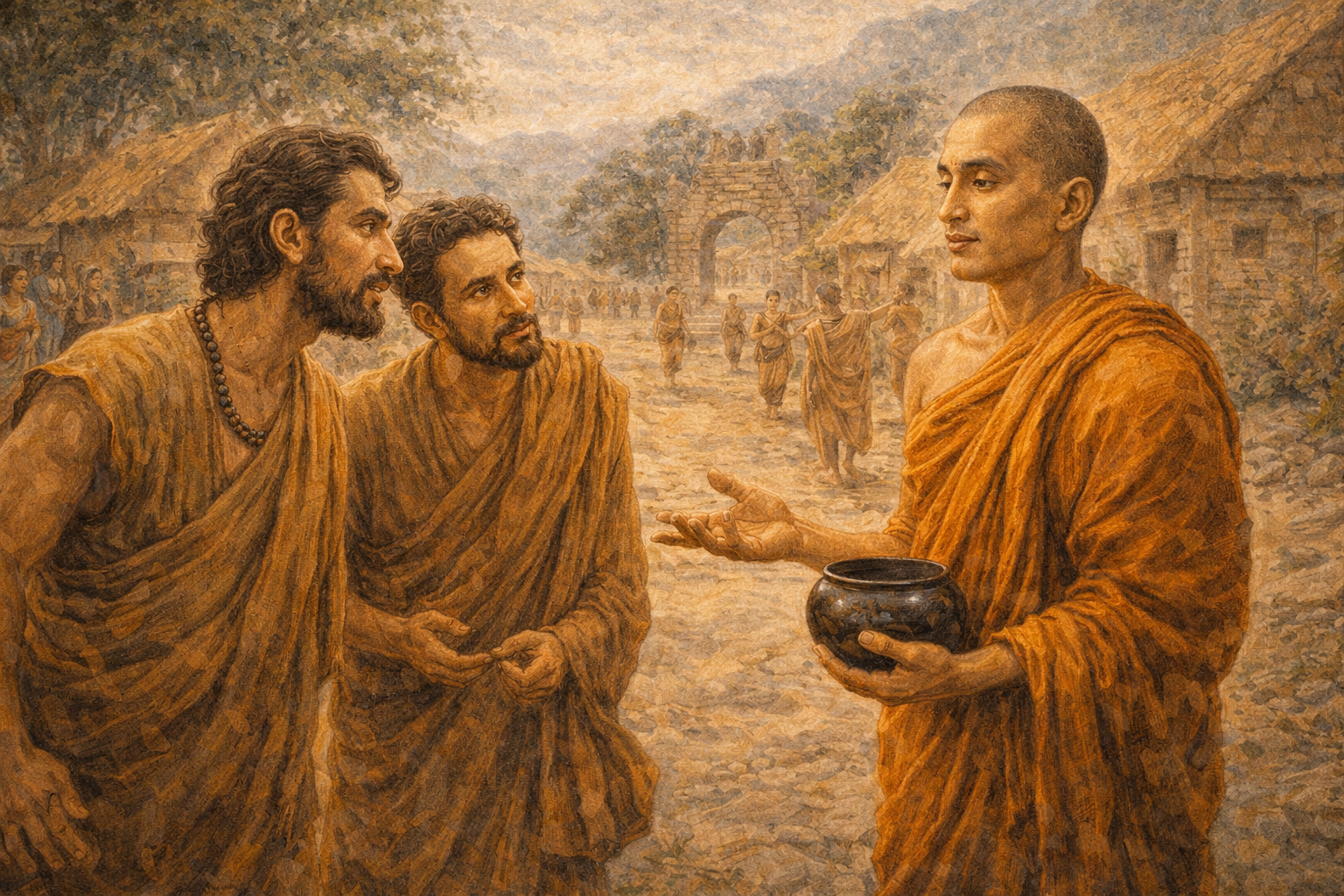
Sariputta — From Wanderer to Chief Disciple
Story: Sariputta and his closest friend Moggallana were wandering ascetics, each leading 250 disciples in their search for truth. One day in Rajagaha, Sariputta noticed a young monk on his alms round whose bearing was so serene and composed that he was immediately drawn to him. The monk was Assaji, one of the Buddha's first five disciples. Sariputta asked respectfully, "Friend, who is your teacher? What teachings do you follow?" Assaji replied humbly that he was new to the path and could only share a single verse: "Of things that arise from a cause, the Tathagata has told the cause, and also what their cessation is — this is the teaching of the Great Sage." Upon hearing just those two lines, Sariputta attained stream-entry — his first direct glimpse of Nibbana. He ran back to Moggallana, who heard the verse and also attained stream-entry. Together they went to the Buddha, who declared them his two chief disciples — Sariputta foremost in wisdom, Moggallana foremost in spiritual power.
Lesson: A mind prepared by years of sincere seeking can be awakened by a single verse. Sariputta's story illustrates paṭicca-samuppāda: that all things, including insight, arise when the conditions are right.
Reflection: We may spend years searching before encountering the teaching or the teacher that finally opens the door. Sariputta's path teaches us to keep searching with sincerity. When we are truly ready, even a single sentence can change everything.
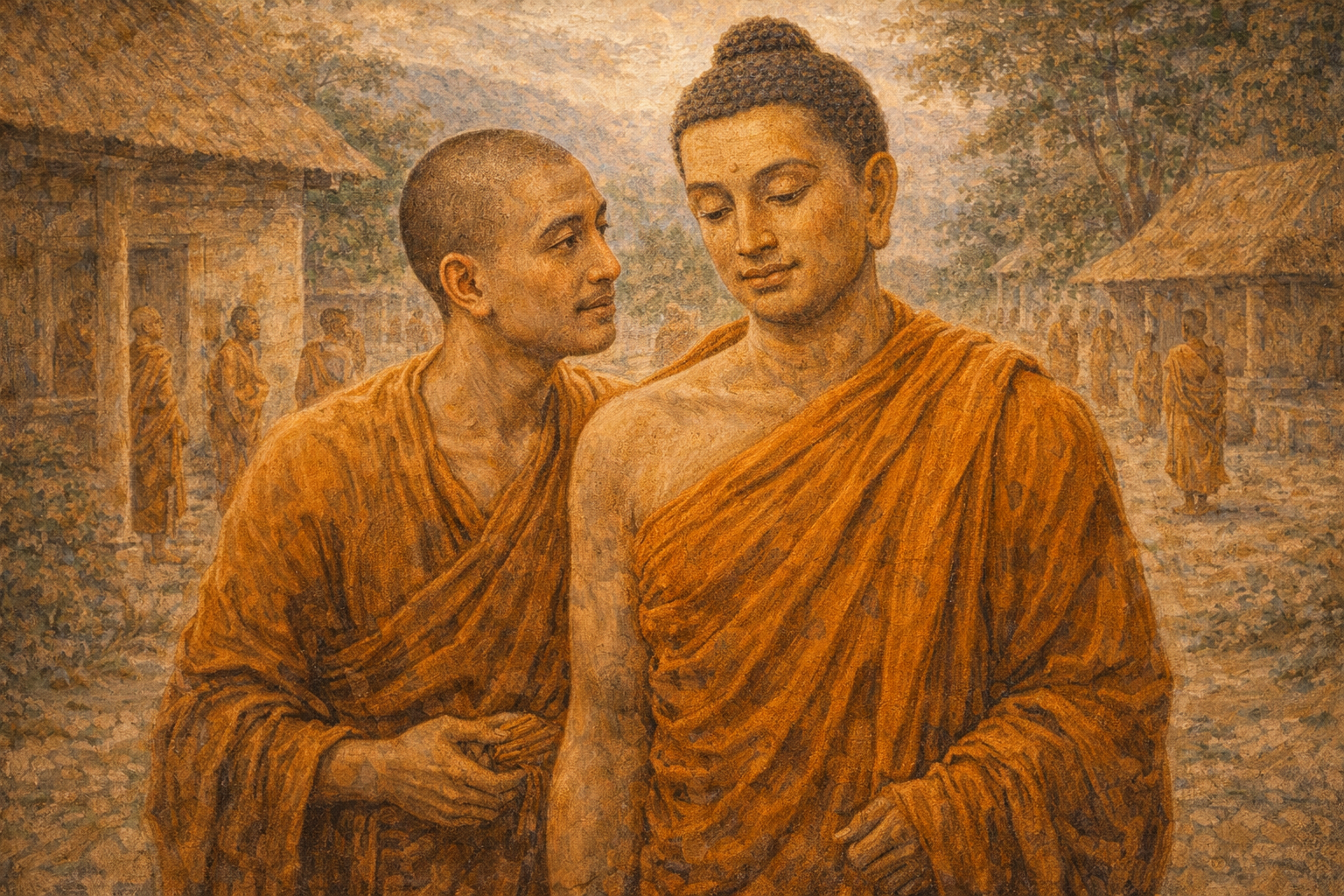
Ananda — The Devoted Attendant
Story: For twenty-five years, Ananda served as the Buddha's personal attendant — walking beside him on every journey, conveying messages, remembering every teaching he heard, and attending to the Buddha's physical needs. Before accepting the role, he requested eight conditions, including that he never receive special robes or food from the Buddha, and that any teaching given in his absence be repeated to him. These conditions ensured no one could accuse him of personal gain. Ananda was known for his warmth and approachability; he was a strong advocate for women, persuading the Buddha to allow the ordination of bhikkhunīs. When the Buddha passed into final Parinibbana, Ananda wept. Driven by grief and duty, he intensified his meditation and attained enlightenment just before the First Council convened — so he could recite from memory every sutta the Buddha had ever taught, beginning each one with the words: "Thus have I heard."
Lesson: Ananda exemplifies devoted, selfless service. His role was not to shine himself but to ensure the Buddha's work would reach the world. The Dhamma we study today exists because Ananda listened with his whole heart.
Reflection: Not everyone's path is to be the teacher. Some are called to serve, to preserve, and to make space for others to flourish. Ananda's life reminds us that serving with a pure heart — without personal ambition — is itself a profound spiritual path.
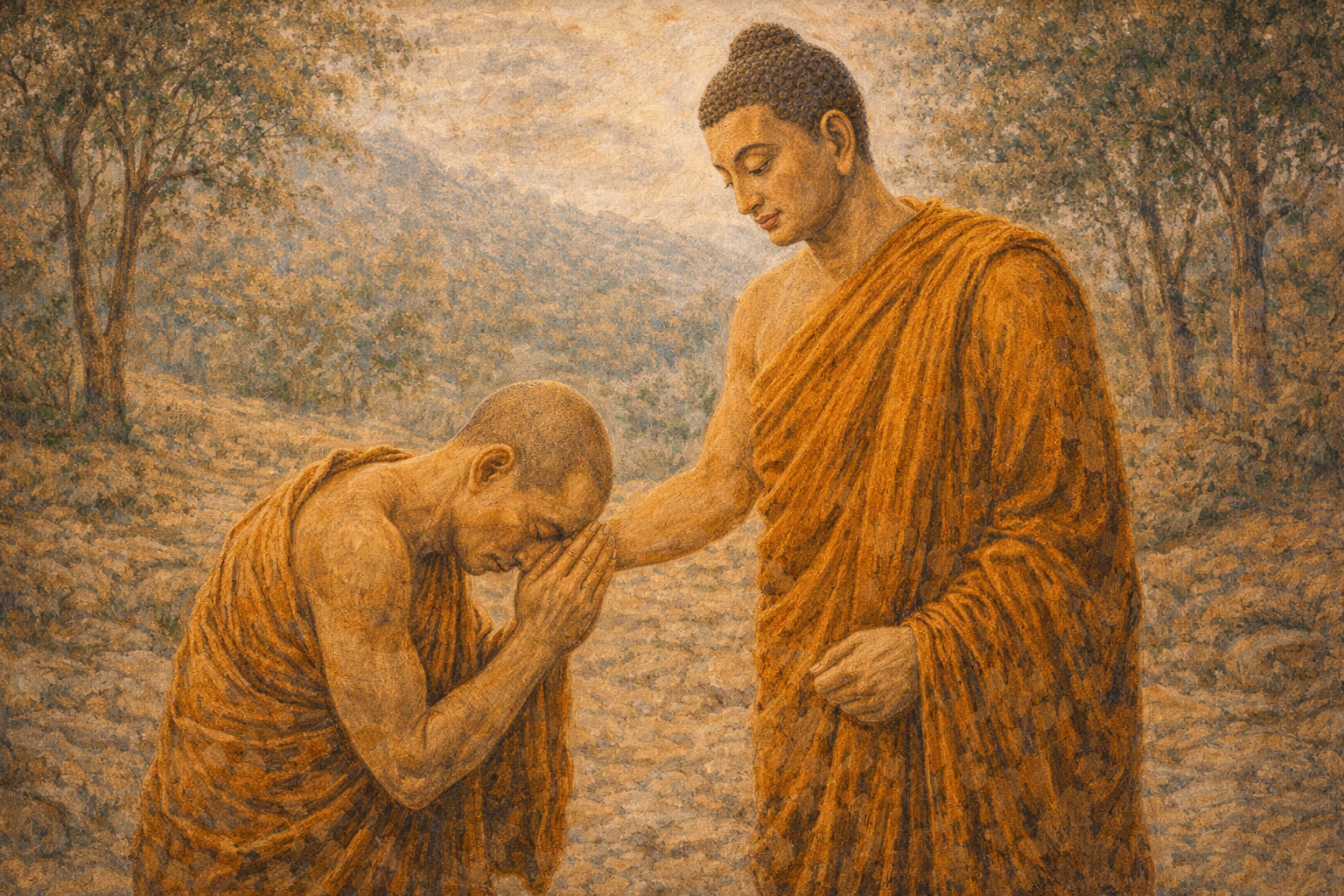
Mahakassapa — Keeper of the Dhamma
Story: Mahakassapa was a wealthy brahmin who, together with his wife, had long sought liberation. On the day they left home as wandering ascetics, they agreed to separate and each seek the finest teacher they could find. Walking a road one day, Mahakassapa came toward the Buddha traveling in the opposite direction. The sight stopped him completely — he immediately knew this was the teacher he had been seeking his entire life. He bowed at the Buddha's feet and asked for ordination. The Buddha accepted him. In an extraordinary gesture of mutual respect, the two later exchanged robes. Mahakassapa became renowned for his strict practice of the dhutaṅga disciplines — sleeping in forests, wearing only robes of rag cloth, eating only from his bowl. After the Buddha's passing, it was Mahakassapa who organized the First Council, where Ananda recited the suttas and Upali recited the Vinaya, preserving the entire teaching in oral form.
Lesson: Mahakassapa's strict discipline was not harshness but deep commitment. His preservation of the Vinaya ensured the Sangha would endure across generations. Without him, the structure and teachings that guide monastics today might not have survived.
Reflection: In an age that prizes flexibility and personal interpretation, Mahakassapa's example offers a counterpoint: there is value in structure, in discipline, and in faithfully holding the line of tradition. Sometimes the most loving thing we can do is carefully preserve what we have been given.
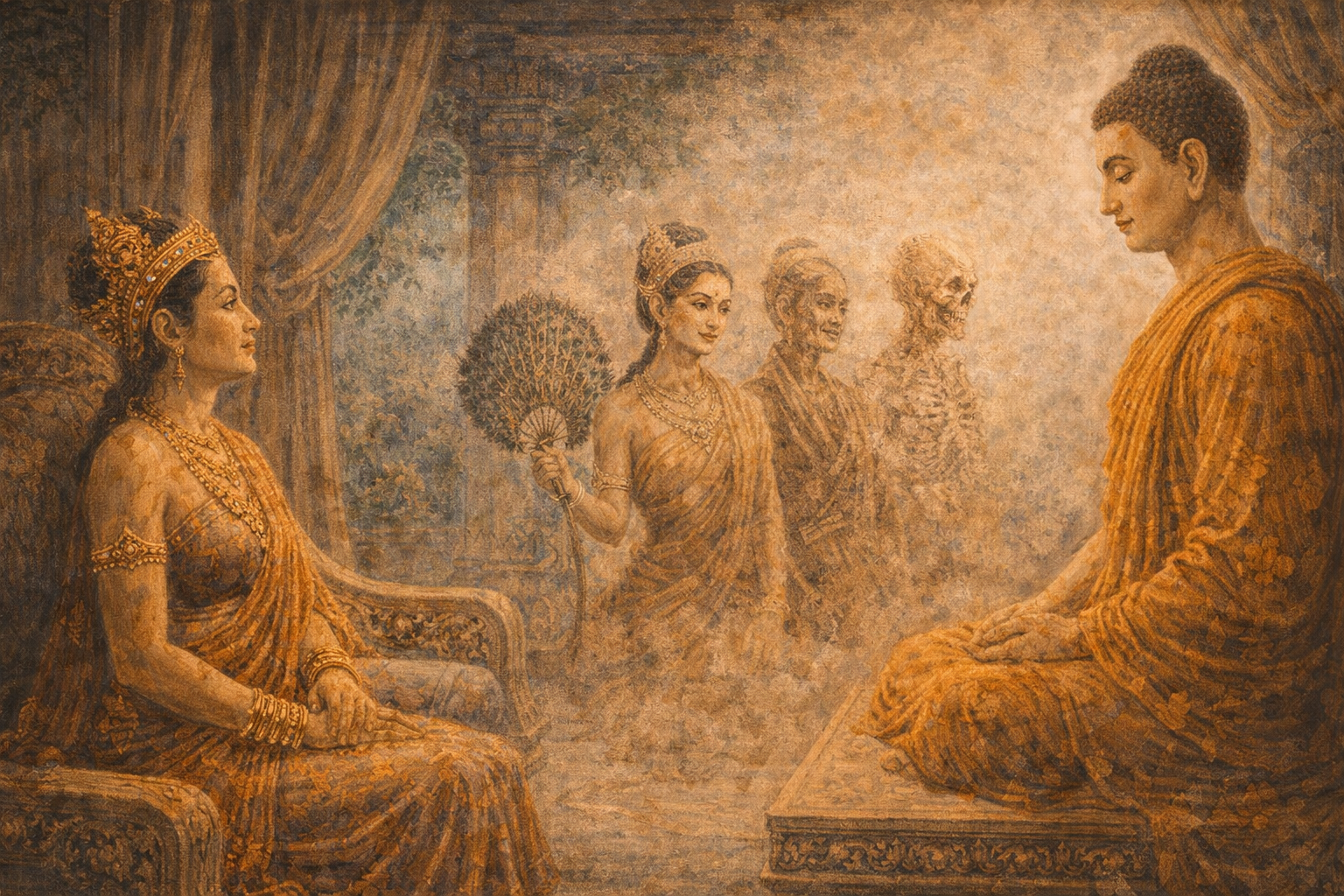
Khema — From Queen to Enlightened Teacher
Story: Khema was the beautiful and beloved chief queen of King Bimbisara of Magadha. She was so attached to her own beauty that she avoided visiting the Buddha, fearing his teachings would diminish her vanity. The king, a devoted follower of the Buddha, arranged for musicians to compose songs praising the beauty of the Jetavana monastery until Khema's curiosity got the better of her. When she finally sat before the Buddha, he used his power to conjure the vision of an extraordinarily beautiful young woman fanning him. Khema watched in fascination — and then watched as the vision aged before her eyes, from youth to old age, to a corpse, to dust. Her attachment to physical beauty shattered in that instant. She saw with piercing clarity the anicca of all form. The Buddha then taught her the Dhamma, and she attained enlightenment on the spot. She became a nun and was declared by the Buddha as the foremost of his female disciples in wisdom.
Lesson: Attachment — even to one's own appearance — is an obstacle to liberation. The Buddha used what Khema was most attached to in order to free her from it. This is not cruelty but profound, skillful compassion.
Reflection: We all have our own version of Khema's mirror — something about ourselves we cling to and are reluctant to examine honestly. What if the first step toward freedom is simply looking, with clear eyes, at the impermanent nature of the thing we hold most dear?
Stories of Laypeople
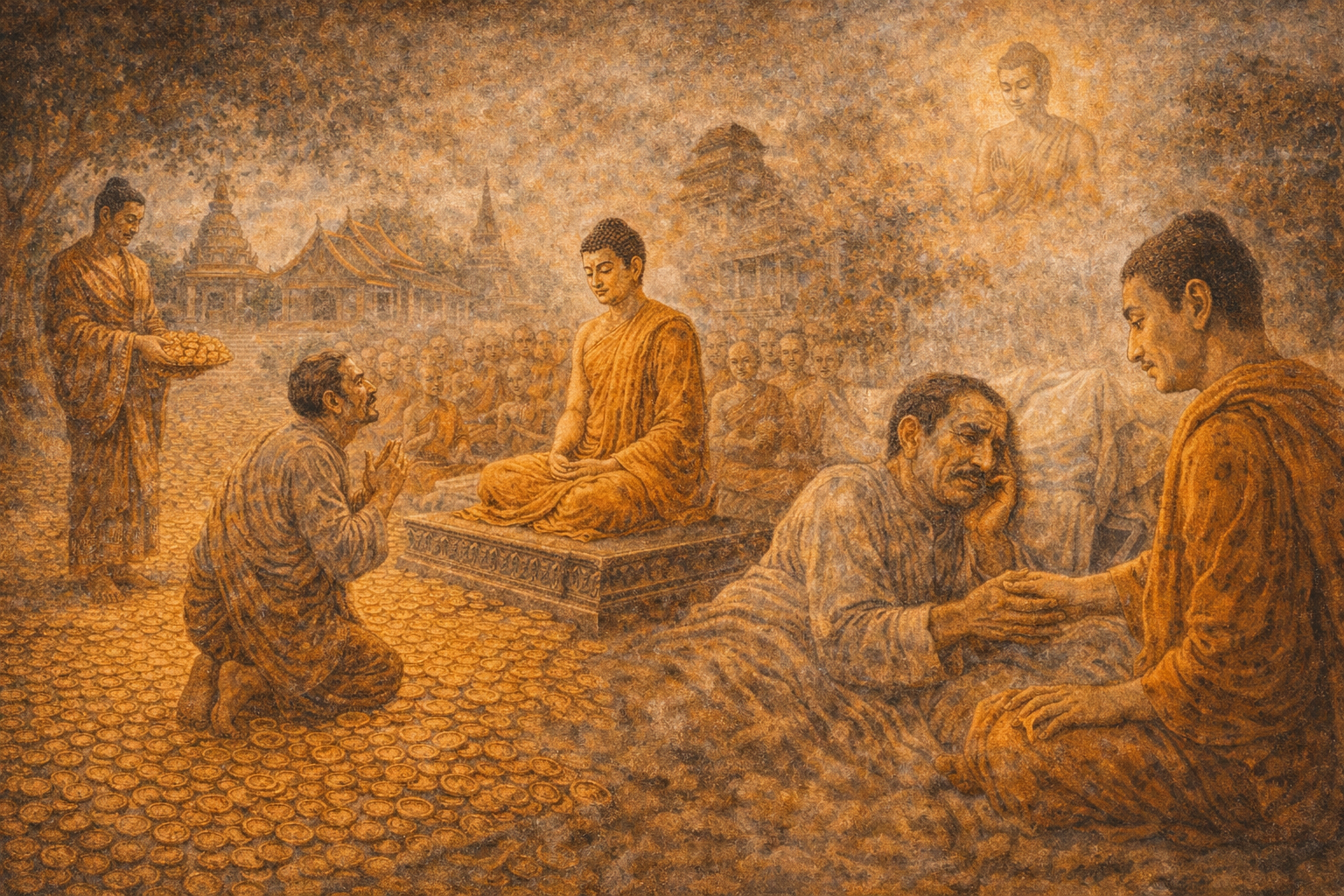
Anathapindika — The Great Benefactor
Story: Anathapindika (meaning "feeder of the helpless") was a wealthy merchant of Savatthi who first encountered the Buddha while visiting a relative in Rajagaha. So moved was he by the Dhamma that he immediately invited the Buddha to teach in Savatthi. To provide a fitting residence, he purchased the park of Prince Jeta at an extraordinary price — according to tradition, he covered the entire ground with gold coins. This park, Jetavana, became the Buddha's primary residence for nineteen rainy seasons and the setting for many of the most beloved suttas. Anathapindika maintained the monastery, feeding hundreds of monks daily for decades. Near the end of his life he faced financial difficulties, yet he continued to give whatever he could. When the elder Sariputta visited him as he lay dying, he led him through a meditation on non-attachment. Tears streamed down Anathapindika's face. "Is something wrong?" Sariputta asked. "No," he replied. "I am weeping because in all my years attending the Blessed One, I have never before heard such a deep teaching." He passed away and was reborn in a heavenly realm.
Lesson: Lay practice can reach the deepest levels of generosity, devotion, and wisdom. Anathapindika's offering of Jetavana created the physical conditions for countless beings to encounter the Dhamma. Dana combined with wisdom is a path of liberation in itself.
Reflection: We may not have gold to cover a field, but we all have something to offer. Anathapindika's story asks: what are we building with our resources that will outlast us and benefit others we may never meet?
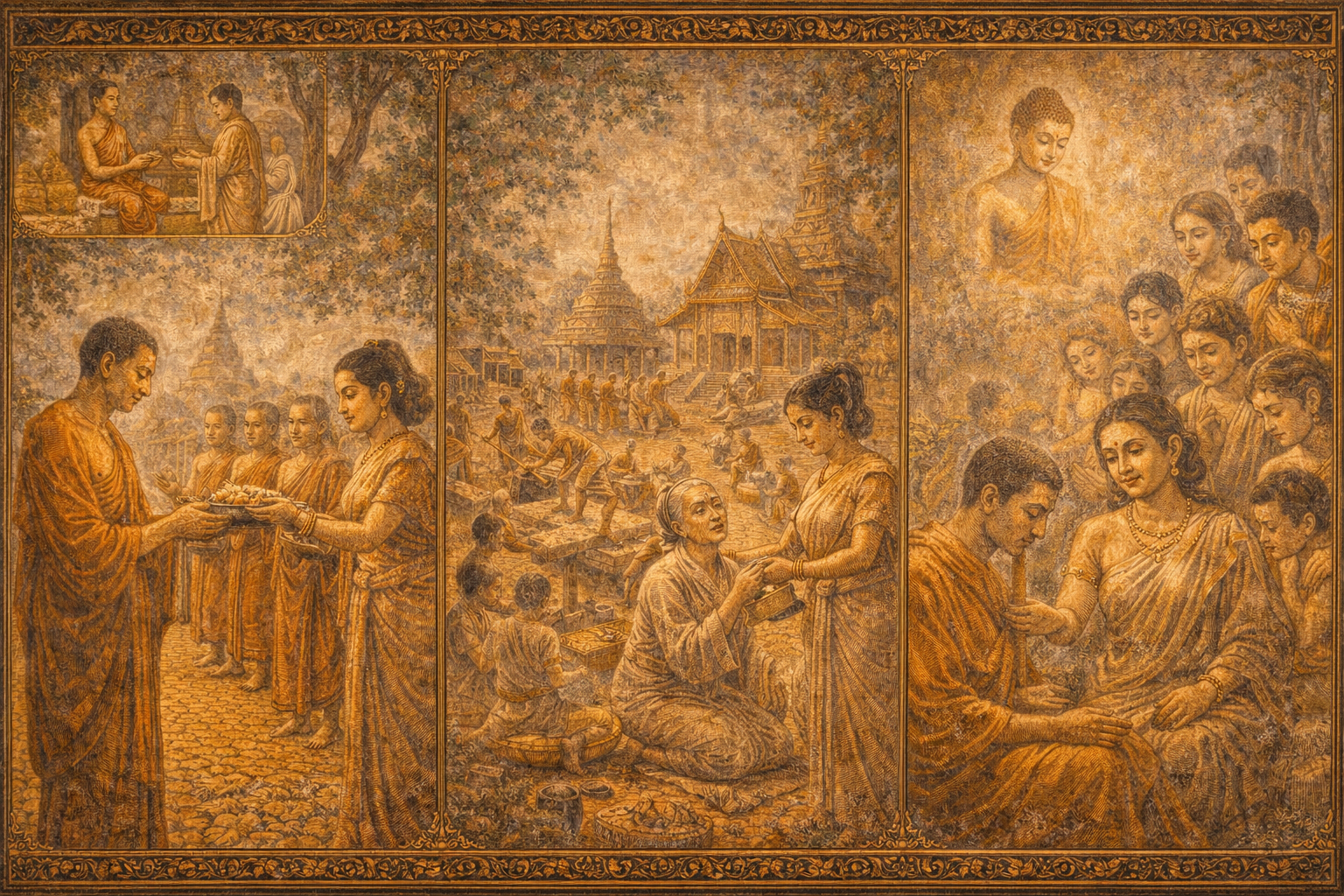
Visakha — The Devoted Laywoman
Story: Visakha was raised by a devout Buddhist grandfather who trained her in the Dhamma from childhood. At just seven years old, she attained stream-entry while listening to the Buddha teach. She married into a wealthy family in Savatthi and used her influence and wealth generously throughout her long life. She is known for her Eight Wishes — eight acts of ongoing support she requested permission to offer the Sangha, including robes for the rains retreat, food for visiting monks, food for the sick, and medicine. She funded the construction of the Eastern Monastery as a residence for nuns. Visakha bore many children and grandchildren, all of whom she outlived. She never let grief break her devotion. When the Buddha asked how she remained so joyful despite her losses, she replied that she had so many loved ones that there was always someone being born and someone passing away — and she had learned not to cling to any of them.
Lesson: Visakha embodies the highest lay practice: generosity, upekkha, and wisdom woven into the fabric of ordinary domestic life. Her Eight Wishes show how a deeply compassionate person thinks practically and systematically about the needs of others.
Reflection: Visakha's ability to love deeply without grasping is a model for how we might approach our own relationships. She loved her children completely, while holding their presence lightly. This is not coldness — it is the fruit of wisdom.
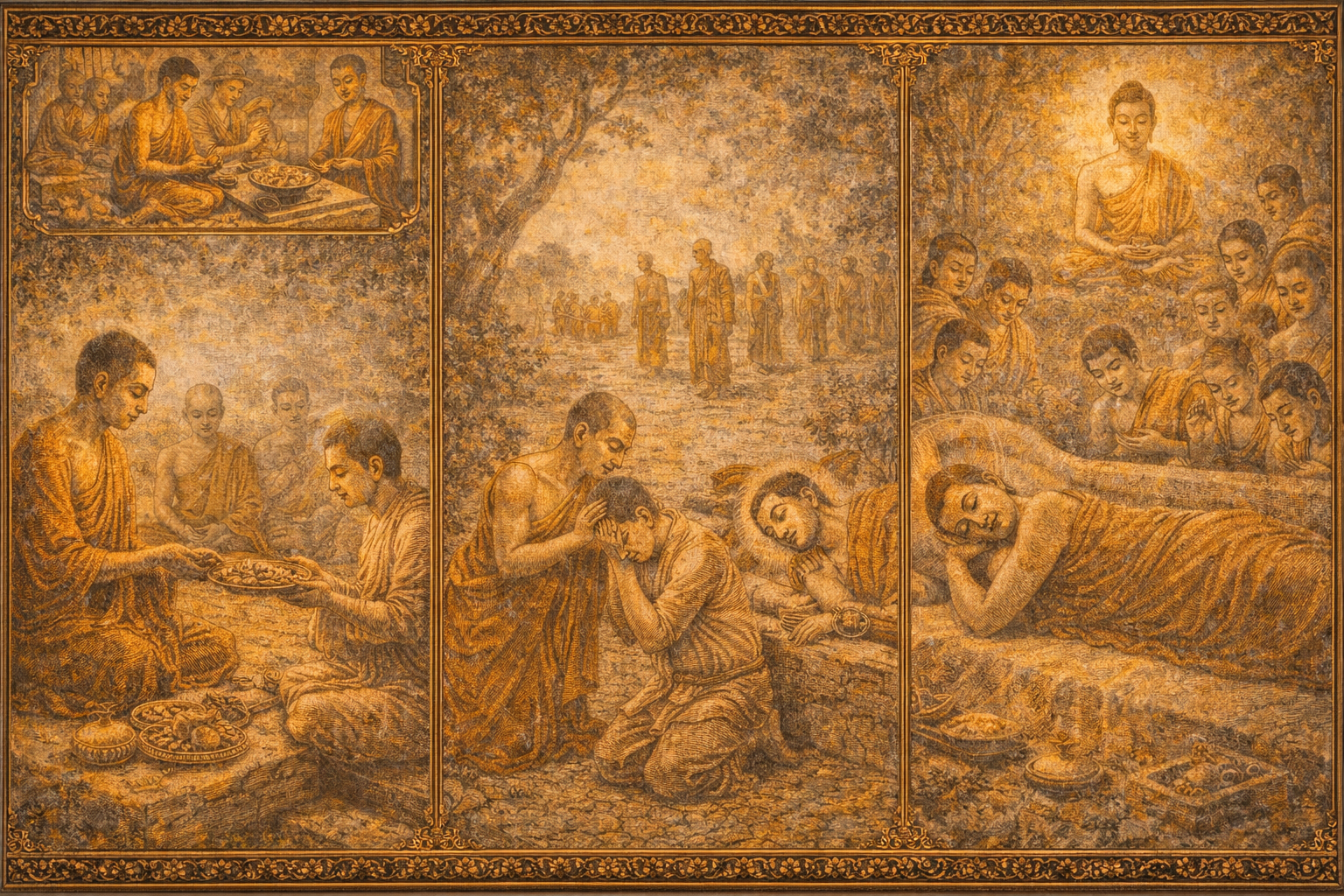
Cunda the Goldsmith — The Last Meal
Story: Cunda was a goldsmith's son in the town of Pava who invited the Buddha and his monks to a meal. He prepared a special dish among other offerings. The Buddha accepted the dish for himself but asked Cunda to serve the other monks different food, and to bury the remainder. Shortly after eating, the Buddha was struck by a severe illness. Despite his pain, he continued walking toward Kushinagar, resting frequently. When the elder Ananda blamed Cunda, the Buddha corrected him firmly: "There are two meals of equal, immeasurable merit," he said. "The meal that preceded my enlightenment — offered by Sujata — and this last meal offered by Cunda. There are no grounds for Cunda to feel remorse. He should feel joy." These were among the Buddha's final teachings. He attained final Parinibbana that night.
Lesson: The Buddha's final act of care was to protect an innocent layperson from a lifetime of false guilt. This teaching — that we must not create suffering where none is warranted — is itself the Dhamma lived in its fullest expression.
Reflection: How quickly do we assign blame — to ourselves or others — when things go wrong, even when the connection is coincidental? The Buddha's compassion extended even to the management of a grieving man's conscience. That is how thorough true kindness can be.
Buddhist History
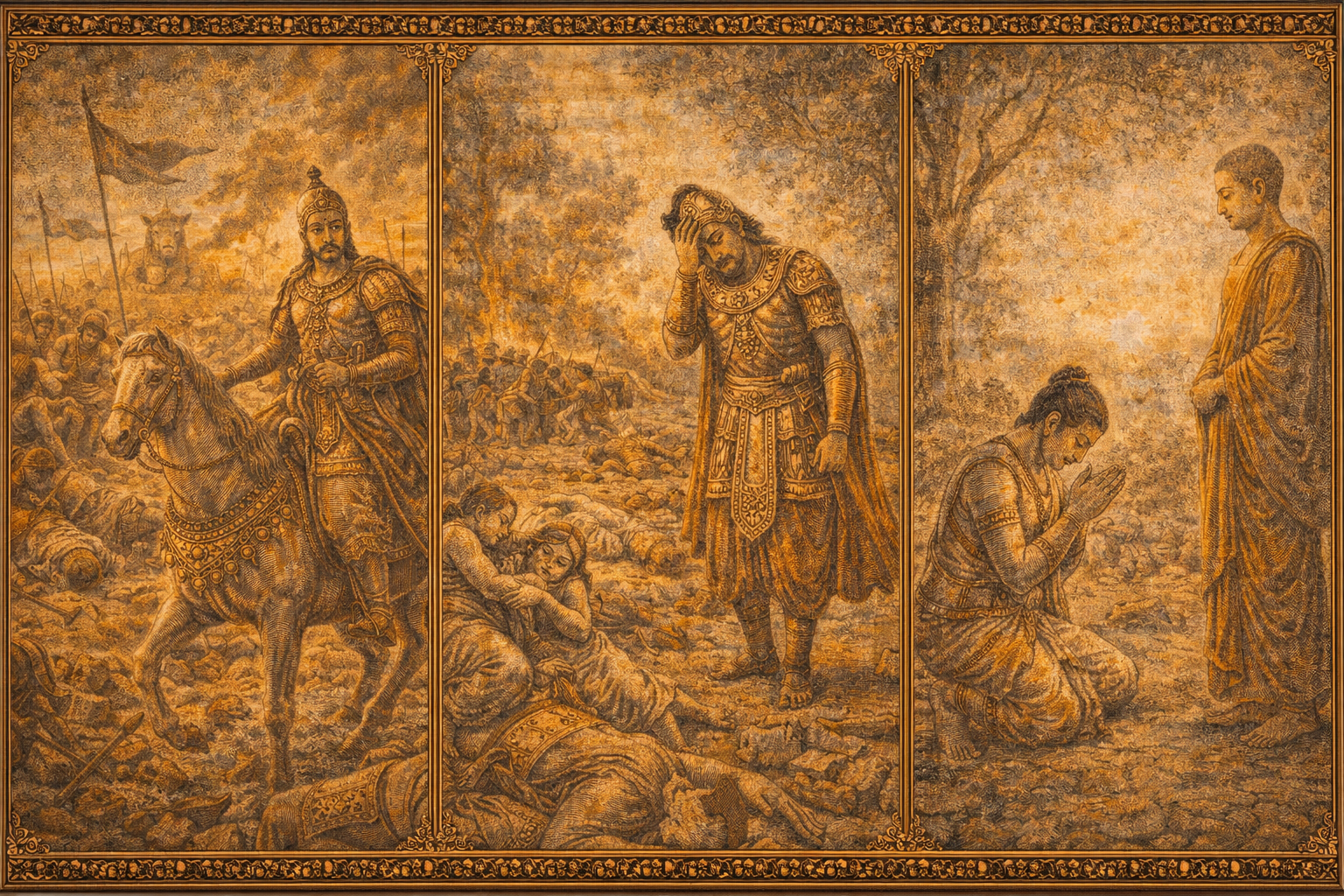
Ashoka and the Kalinga War
Story: In the third century BCE, Emperor Ashoka of the Maurya dynasty was one of the most powerful rulers in the ancient world. His empire stretched across nearly the entire Indian subcontinent. In 261 BCE, he launched a war against the kingdom of Kalinga (present-day Odisha) to add it to his empire. The Kalinga War was one of the bloodiest in ancient Indian history. According to Ashoka's own rock edicts, 100,000 people were killed, another 150,000 were deported, and many more died from the devastation. When Ashoka toured the battlefield and saw the scale of the suffering — the dead, the grieving, the destruction — he was overcome with deep remorse. He had won the war, but what he felt was not triumph. It was horror. This moment of profound reckoning would change the course of his life, and the history of Buddhism, forever.
Lesson: The consequences of kamma are real and far-reaching. Ashoka's grief was not weakness — it was the beginning of wisdom. Recognizing the suffering we have caused is the essential first step toward change.
Reflection: Ashoka had immense power and used it to cause immense harm — and then chose to transform. His story asks us to look honestly at the effects of our own actions, however large or small, and to ask: what kind of world am I helping to create?
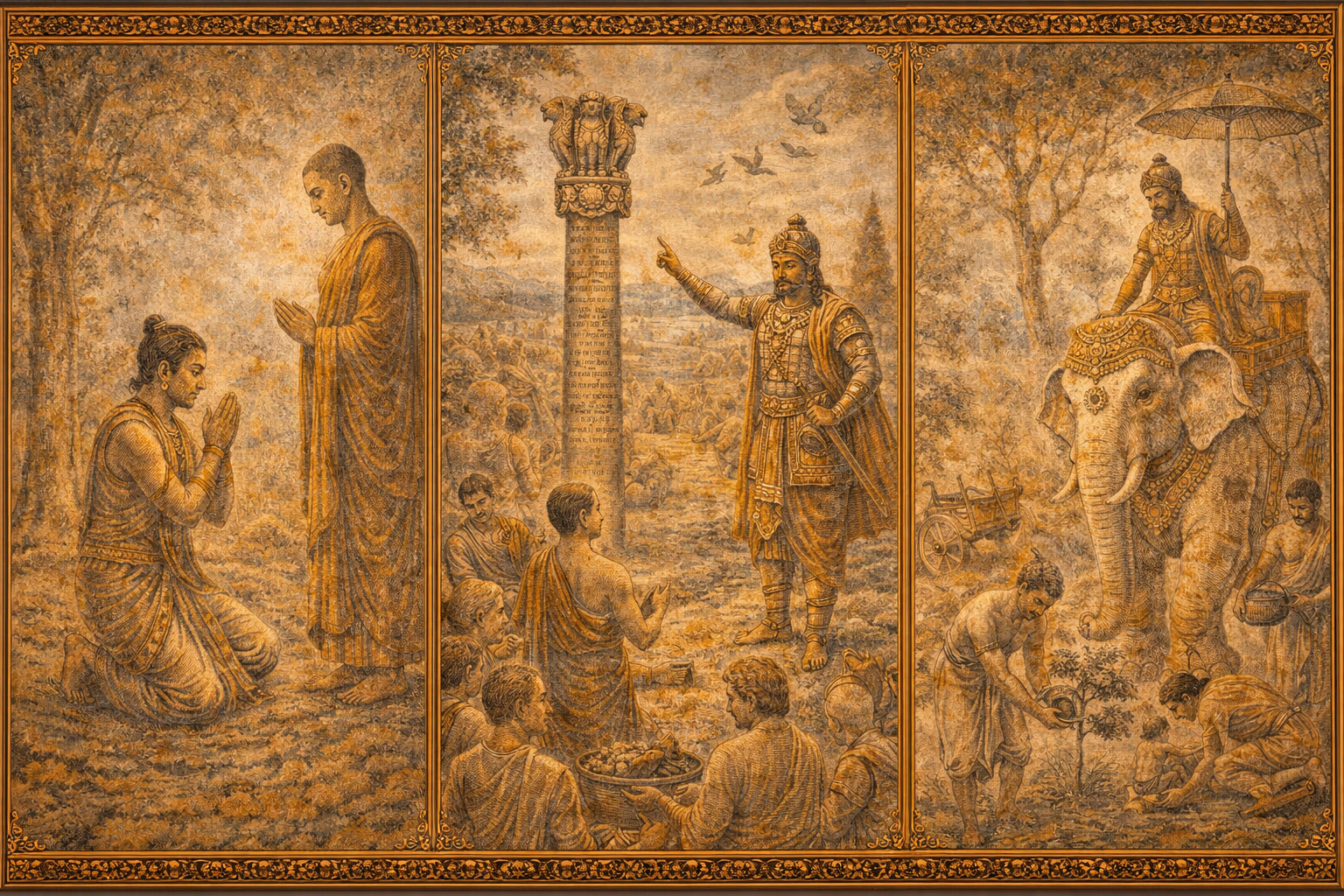
Ashoka's Conversion — A King Embraces the Dhamma
Story: Following the Kalinga War, Ashoka turned to the Buddhist teachings in his search for a path that could redeem what he had done. He became a devoted lay follower of the Buddha's Dhamma and began a radical transformation of his rule. He renounced war as an instrument of conquest and adopted a policy of Dhamma-vijaya — conquest by righteous example rather than by the sword. He sent ambassadors of peace rather than armies across borders. He carved his principles — the promotion of non-violence, compassion, respect for all living beings, support for the poor and the sick, and tolerance for all religious traditions — into rock edicts that were posted throughout the empire. He built hospitals, planted trees along roads for shade, dug wells for travelers, and established rest houses for the weary. He was the first ruler in recorded history to ban the killing of many species of animals by royal decree.
Lesson: The Dhamma is not only a path for individuals seeking personal liberation — it can be a force for transforming entire societies. Ashoka's reign demonstrates what governance guided by karuṇā and metta can look like in practice.
Reflection: We do not need to be emperors to put Buddhist principles into practice in our public and civic lives. Ashoka's example asks: how do the values we hold in meditation translate into the way we live, lead, vote, and care for our communities?
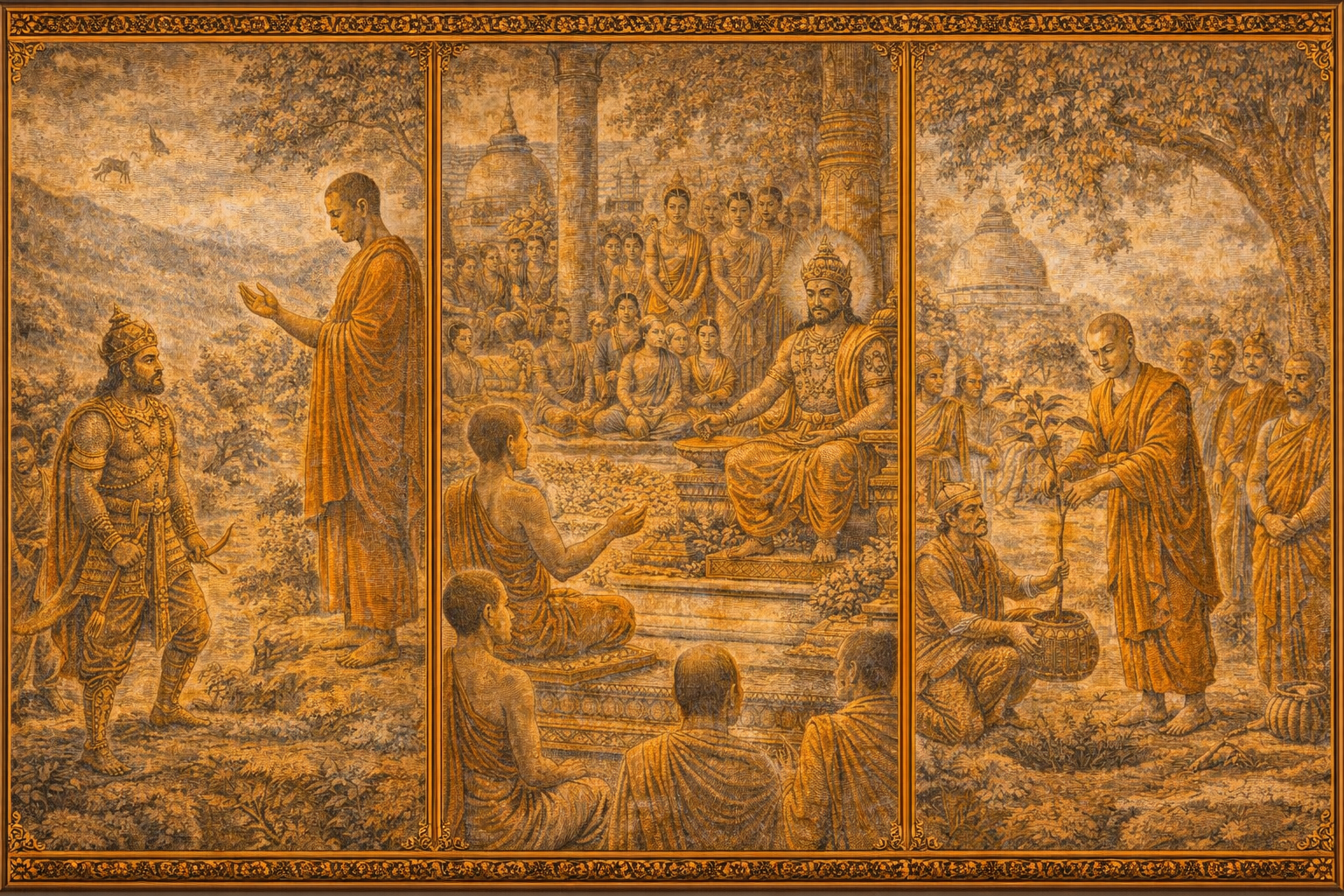
Mahinda Brings the Dhamma to Sri Lanka
Story: Among Ashoka's greatest contributions to the history of Buddhism was his active support for spreading the Dhamma beyond India. His own son, the monk Mahinda, led a mission to the island of Lanka (present-day Sri Lanka) around 247 BCE. On the full-moon day of the month of Poson, Mahinda and his companions descended on Mihintale Hill, where they encountered King Devanampiya Tissa hunting deer. Mahinda tested the king's wisdom with a riddle about a mango tree, and finding him both sharp and receptive, proceeded to teach him the Dhamma. The king listened with an open heart and was deeply moved. He invited Mahinda and his monks to Anuradhapura, the capital, where Mahinda taught the entire court. The king converted, and the Sangha was established in Lanka. Mahinda's sister Sanghamitta later brought a branch of the original Bodhi tree from Bodh Gaya to Lanka, where it was planted at Anuradhapura — where it still grows today, the oldest documented tree in the world, 2,300 years old.
Lesson: The Theravada Buddhism practiced in Sri Lanka, Myanmar, Thailand, Cambodia, Laos — and at Virginia Bouddha Vihar today — traces its lineage directly to this mission. The Dhamma was not imposed but offered with wisdom and respect. It took root because it was received with a genuinely open mind.
Reflection: The living Bodhi tree at Anuradhapura is a remarkable symbol: a tree grown from the tree under which the Buddha gained enlightenment, still growing more than two millennia later. The Dhamma, when genuinely received and faithfully maintained, can endure across centuries and continents. What will we pass on?
Buddhism in Bangladesh
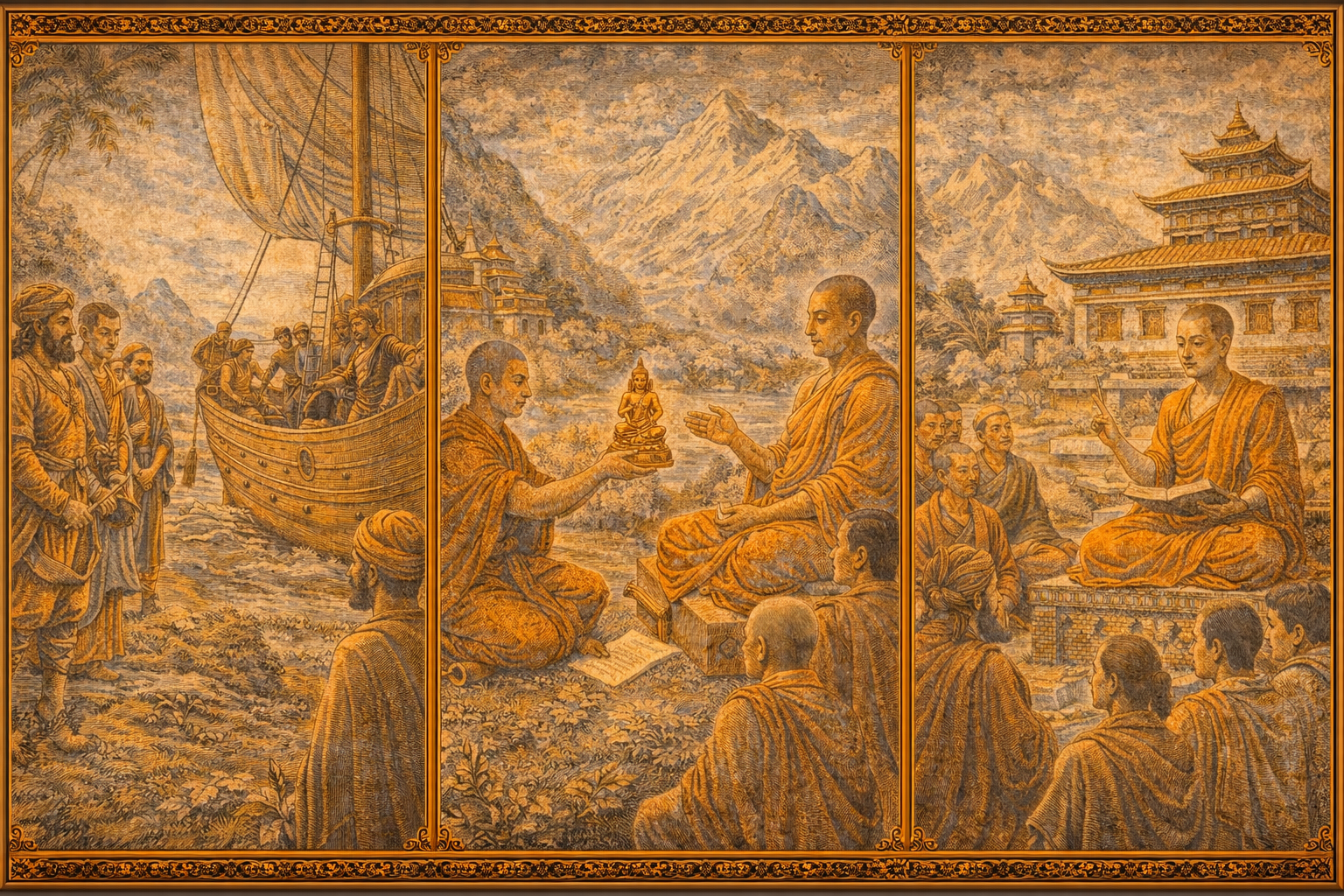
Atisha Dipankara — The Light of Bengal
Story: Around 982 CE, a boy was born in Vikramapura — a city in the kingdom of Vaggadesa in what is now Munshiganj district, Bangladesh. His name was Atisha Dipankara Shrijnana. He was born into a royal family but turned from wealth toward the Dhamma from a young age. He studied at the great Buddhist universities of Bengal and then at Vikramashila vihāra — one of the greatest Buddhist institutions in the ancient world, founded by the Pala kings. But one teaching drew him further still: the complete cultivation of bodhicitta. Believing the deepest transmission of this teaching resided with the master Dharmakirti in Suvarnadvipa (Sumatra), Atisha undertook a thirteen-month sea voyage to find him. He studied in Sumatra for twelve years. He returned to Bengal transformed — and the most celebrated Buddhist scholar of his era.
When he was around fifty, a young Tibetan monk arrived carrying a golden statue and a letter from King Jangchub Ö, who had been laboring for years to revive Buddhism in Tibet after a period of persecution. Atisha accepted the invitation and made the long journey over the Himalayas. In Tibet he composed the Bodhipathapradipa — "A Lamp for the Path to Enlightenment" — a concise text that organized the entire Buddhist path into a graduated framework accessible to practitioners of all levels. This text became the foundation of the Lam Rim tradition that shaped all subsequent Tibetan Buddhism. He spent the rest of his life teaching in Tibet and passed away at the monastery of Nyethang in 1054 CE. His tradition continues to this day in millions of practitioners across the world — a tradition born in Bengal.
Lesson: Atisha left a kingdom, crossed an ocean, and crossed the Himalayas in pursuit of wisdom. His story embodies the viriya — energy and effort — that the path requires, and the kalyāṇamitta, the spiritual friendship, that makes it possible.
Reflection: Bangladesh is not often thought of as a birthplace of Buddhism's global spread — yet a boy born in Munshiganj helped carry the Dhamma to Tibet, and through Tibet to millions in the modern world. What might each of us carry forward, if we choose to?
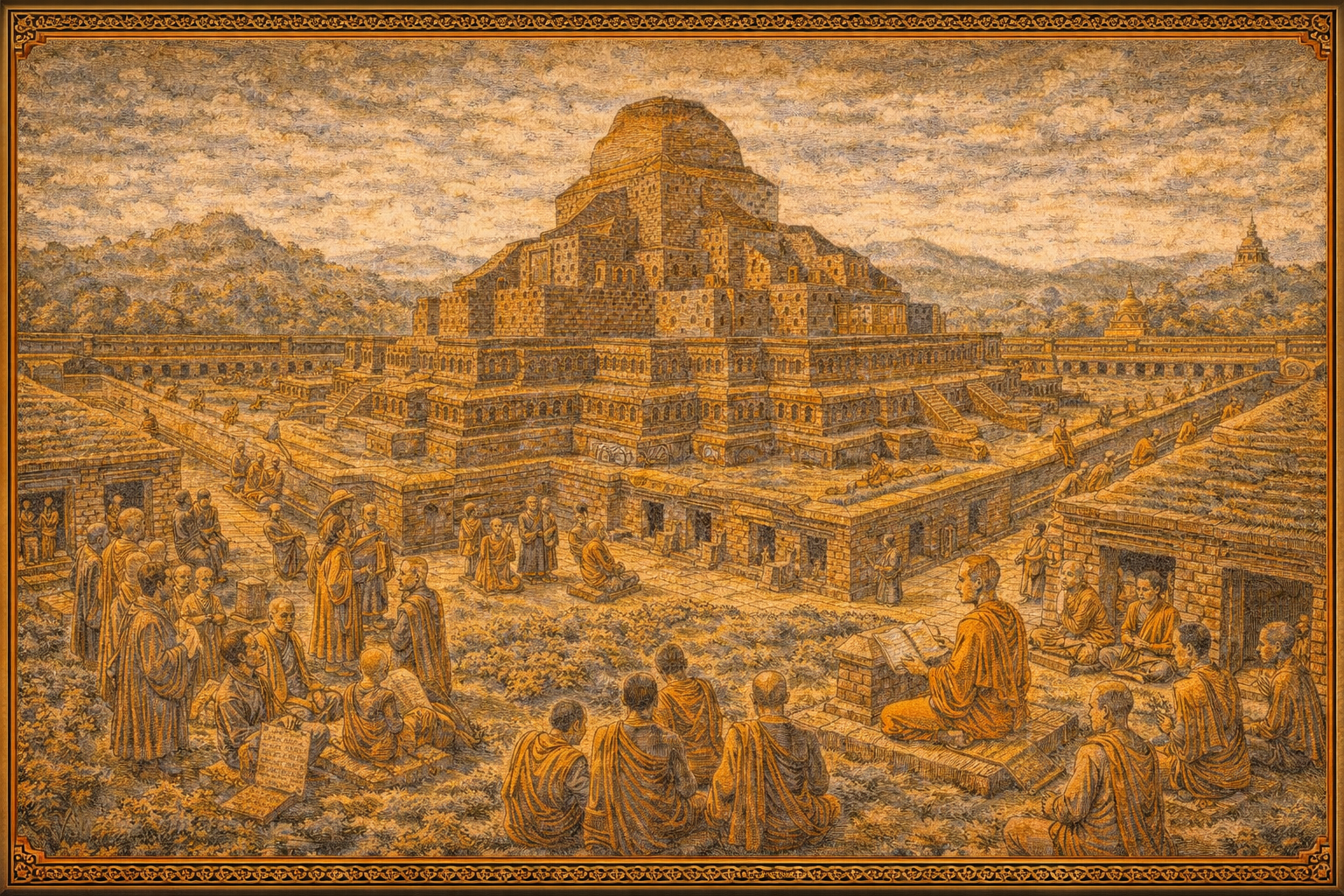
Somapura Mahavihara — The Great Monastery of Paharpur
Story: In the eighth century CE, the Buddhist Pala dynasty rose to power in Bengal — the land that is now Bangladesh and the Indian state of West Bengal — inaugurating a four-hundred-year golden age of Buddhism in the region. The Pala kings were among the most generous patrons of the Sangha in all of Buddhist history. They built, funded, and protected the great mahāvihāras that served as the universities of the ancient Buddhist world.
The greatest of all their foundations was Somapura Mahavihara, built by the second Pala king, Dharmapala (r. 770–810 CE), at what is now Paharpur in Naogaon district, Bangladesh. Its central terrace complex covered over twenty-seven acres. Its cruciform main temple rose in stepped tiers decorated with hundreds of terracotta panels depicting Buddhist, Hindu, and Jain themes. Around the temple's perimeter stood 177 monks' cells — rooms for practitioners who had come from across Asia to study. Inscriptions and artifacts found at the site show that scholars arrived from Tibet, China, Myanmar, and Southeast Asia, drawn by the depth of learning available there. The Chinese pilgrim Yijing described Bengali vihāras in the 7th century as rivaling anything he had seen anywhere in Asia. Somapura remained active for nearly four centuries before being destroyed during the invasion by Bakhtiyar Khilji in the early 13th century.
Today the ruins of Somapura Mahavihara are a UNESCO World Heritage Site — the largest Buddhist monastery ever discovered in the Indian subcontinent. The site stands in Bangladesh as a quiet testament to the extraordinary Buddhist civilization that once flourished here.
Lesson: The Dhamma flourishes when communities invest in the Sangha — in monasteries, schools, and teachers. The Pala kings' generosity created conditions in which the light of paññā could shine for centuries and illuminate the world far beyond Bengal.
Reflection: Paharpur is a site of great beauty and great sorrow — a civilization deliberately destroyed. But the knowledge it carried had already spread far and wide. This is the nature of the Dhamma: even when its physical forms are burned, what has been genuinely understood cannot be taken away. What are we building — within ourselves and in our community — that will outlast us?
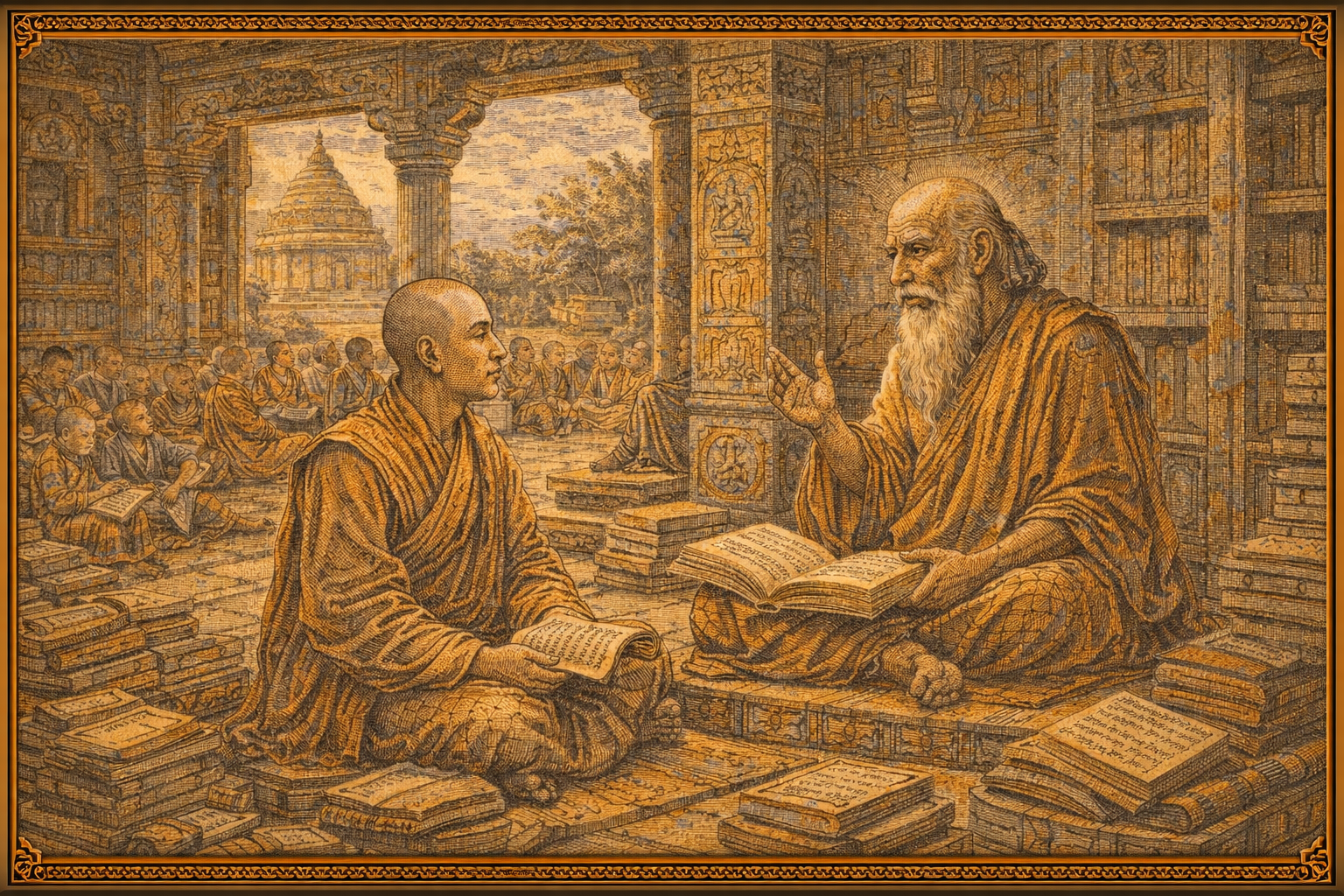
Shilabhadra — The Bengali Scholar Who Taught the World
Story: In the seventh century CE, a young monk from the Samatata region of Bengal — corresponding to the southeastern coastal districts of present-day Bangladesh — had risen through decades of study and practice to become the ācariya of Nalanda Mahavihara: the greatest university in the ancient world, at its height housing over ten thousand students and monks from across Asia. His name was Shilabhadra, and he was over one hundred years old.
It was in this role that Shilabhadra received the young Chinese monk Xuanzang — known in China as the "Monk of the Tang" — who had traveled for three years across the deserts and mountains of Central Asia to reach Nalanda. Xuanzang studied under Shilabhadra for many years, mastering the Yogacara philosophy, the Abhidhamma, and a vast range of Buddhist texts. When he finally returned to China carrying hundreds of manuscripts, he translated them into Chinese over the remaining decades of his life, creating a body of Buddhist literature that shaped Chinese, Japanese, Korean, and Vietnamese Buddhism to this day. The entire Tang-dynasty tradition of Chinese Buddhism — and through it the Zen, Pure Land, and Tiantai schools that still flourish — flowed in part through Shilabhadra's teachings.
Xuanzang's journey later inspired the classic Chinese novel Journey to the West, one of the most beloved works of Asian literature. But behind the mythological journey of Sun Wukong and the Monkey King, there is the true story of a young man's incredible pilgrimage — and an old Bengali scholar who received him with patience, depth, and generosity.
Lesson: A kalyāṇamitta — a genuine spiritual friend and teacher — can change the entire course of a student's life, and through that student, the lives of millions. Shilabhadra did not travel; he did not write great texts. He simply taught, with great depth, to whoever arrived at his door.
Reflection: How much of what the world knows of Buddhism traces back, through long chains of transmission, to teachers in Bengal? History rarely credits the places where wisdom was first cultivated. The next time you read a Buddhist text, there may be a thread of Bangladeshi scholarship woven through it that you would not suspect.
Pali Glossary
Pali is the ancient language in which the Theravada scriptures were recorded. Tap or hover over italicized terms in the stories above to see their meanings, or browse the glossary below.
- anicca
- Impermanence — the truth that all conditioned things arise and pass away. One of the Three Marks of Existence.
- anatta
- Non-self — the truth that no fixed, permanent self exists in any phenomenon. One of the Three Marks of Existence.
- bhikkhunī
- A fully ordained Buddhist nun. The Bhikkhunī Sangha was founded by Mahapajapati Gotami with the support of Ananda.
- Bodhisatta
- A being on the path to full Buddhahood, cultivating the perfections (paramis) over many lifetimes. The Buddha in his past lives is referred to this way.
- dana
- Generosity — the first of the ten perfections and the foundation of lay Buddhist practice.
- Dhamma
- The Buddha's teachings; also the nature of reality and cosmic truth. One of the Three Jewels.
- dhutaṅga
- Ascetic practices voluntarily undertaken by monks to reduce attachment and strengthen resolve.
- dukkha
- Suffering / unsatisfactoriness — the truth that conditioned existence is inherently unsatisfying. The First Noble Truth.
- kamma
- Intentional action and its consequences — the law of moral cause and effect.
- karuṇā
- Compassion — the wish to relieve the suffering of all beings. One of the Four Divine Abodes (brahmavihāras).
- metta
- Loving-kindness — the wish for all beings to be happy and well. One of the Four Divine Abodes.
- muditā
- Sympathetic joy — taking genuine delight in the happiness and success of others. One of the Four Divine Abodes.
- Nibbana
- Liberation — the complete extinguishing of greed, hatred, and delusion. The goal of Buddhist practice.
- paramis
- The ten perfections cultivated over many lifetimes: generosity, morality, renunciation, wisdom, energy, patience, truthfulness, determination, loving-kindness, and equanimity.
- Parinibbana
- The complete, final liberation of an enlightened being at the time of death — passing beyond all further rebirth.
- paṭicca-samuppāda
- Dependent origination — the teaching that all phenomena arise in dependence on causes and conditions. Nothing exists independently or permanently.
- sacca
- Truthfulness — one of the ten perfections. Also the word for "truth" in the Four Noble Truths (ariya-sacca).
- Sangha
- The community of practitioners — monks, nuns, and lay followers. One of the Three Jewels.
- sīla
- Morality / ethical conduct — one of the three pillars of the Noble Eightfold Path, alongside wisdom and meditation.
- stupa
- A dome-shaped relic shrine, originally built to enshrine the remains of the Buddha or great teachers. Circumambulating a stupa is a traditional act of veneration.
- upekkha
- Equanimity — the balanced, unshakeable quality of a well-trained mind. One of the Four Divine Abodes.
- vihāra
- A monastery — the dwelling place of the Sangha. The word is preserved in place names across South and Southeast Asia, including "Bihar" (India) and "Bouddha Vihar" in our own temple's name.
- viriya
- Energy / effort — one of the ten perfections and one of the Five Spiritual Faculties. The persevering effort that sustains practice through difficulty.
- Vinaya
- The code of monastic discipline for monks and nuns, preserved and recited at the First Council by the elder Upali.
- bodhicitta
- The aspiration to attain full enlightenment for the benefit of all beings — described as the heart of the Mahayana and Vajrayana Buddhist path. Cultivated over many lifetimes.
- kalyāṇamitta
- Spiritual friend or teacher — one who supports and guides another on the path. The Buddha called the kalyāṇamitta "the whole of the holy life," not merely a part of it.
- ācariya
- Teacher / master — an honorific for a senior monastic who serves as a preceptor or mentor. An ācariya takes responsibility for a student's spiritual development.
- mahāvihāra
- A great monastery — a major center of Buddhist learning, practice, and community. The great mahāvihāras of Bengal (like Vikramashila and Somapura) were universities of the ancient world.
- paññā
- Wisdom — one of the three pillars of the Noble Eightfold Path (alongside sīla and samādhi). The direct, clear seeing of the three characteristics: impermanence, suffering, and non-self.
- samādhi
- Meditative concentration — the collected, unified state of mind developed through meditation practice. One of the three pillars of the Noble Eightfold Path.
- tanhā
- Craving / thirst — the Second Noble Truth. The arising of suffering is rooted in craving: for sensual pleasure, for continued existence, and for non-existence.
- Abhidhamma
- The higher teachings — the third basket of the Tipiṭaka, containing detailed philosophical and psychological analysis of mind, matter, and reality.
- Tipiṭaka
- The "Three Baskets" — the complete canon of Theravada Buddhist scripture, comprising the Vinaya (monastic code), the Sutta Piṭaka (discourses), and the Abhidhamma Piṭaka (higher teachings).
- Lam Rim
- The "Graduated Path" — a Tibetan Buddhist teaching framework systematizing the entire path to enlightenment. Originates with Atisha Dipankara's Bodhipathapradipa, written in the 11th century.